Posts

Showing posts with the label Electrostatic Field

Vector Analysis & Electrostatics - Index / Sitemap.

INDEX Vector analysis is a mathematical tool with which electromagnetic (EM) concepts are most conveniently expressed. It's important to learn its rules and techniques first applying it. VECTOR ALGEBRA: - Scalars and Vectors. - Unit Vectors. - Position and Distance Vectors. - Vector Multiplication. - Components Of a Vector. - Numericals / Solved Examples. COORDINATE SYSTEMS & TRANSFORMATION: In general, the physical quantities in ElectroMagnetics are functions of space and time. In order to describe the spatial variations of the quantities, its important to define all points uniquely in space in a suitable manner. This requires using an appropriate coordinate system. Hence its very important to understand the coordinate system first.  - Introduction To Coordinate System. - Cartesian Coordinate System / Rectangular Coordinate System (x, y, z). - Differential Analysis Of Cartesian Coordinate System. - Circular Cylindrical Coordinate System (ρ, φ, z)...
Conductors (Isolated & Non-Isolated) In Electric/Electrostatic Field.

Image
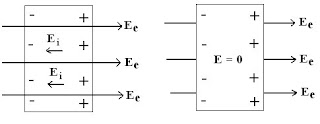
- A conductor (such as Copper, Aluminum, gold) contains electrons that are not bounded to the atom and are free to move within the material. - When an isolated conductor is placed in an external electric field E e , the negative charges ( electrons ) starts moving in the opposite direction to that of electric field. - Soon the electrons get accumulated on the surface of one side of the conductor , while the surface on the other side gets depleted of electrons and hence acquire a positive charge (+ve). - These separated negative (-ve) and positive charges (+ve) on the opposite sides of the conductor produces an internal induced electric field E i which opposes the external field E e inside the conductor. - If the conductor is a perfect conductor or a good conductor the internal electric field E i will cancel the external electric field E e . Hence we can therefore say that “A perfect conductor cannot contain an electrostatic field inside it.” - There ...

Properties Of Materials & Electric Current - Electric Fields In Material Space.

Image
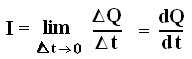
- Electric field can not only exist in free space and vacuum but also in any material medium. - When an electric field is applied to the material, the material will modify the electric field either by strengthening it or weakening it, depending on what kind of material it is. - Materials are classified into 3 groups based on conductivity / electrical property:           - Conductors (Metals like Copper, Aluminum, etc.) have high conductivity (σ >> 1).           - Insulators / Dielectric (Vacuum, Glass, Rubber, etc.) have low conductivity (σ << 1).           - Semiconductors (Silicon, Germanium, etc.) have intermediate conductivity . - Conductivity (σ) is a measure of the ability of the material to conduct electricity . It is the reciprocal of resistivity (ρ). - Units of conductivity are Siemens/meter and mho. - ...

Solved Exercise/Numericals - Electrostatic Energy & Energy Density.

Image
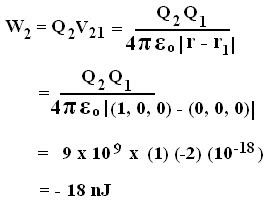
Q.1 Point charges Q 1 = 1 nC, Q 2 = -2 nC and Q 3 = 3 nC and are positioned one at a time and in that order at (0, 0, 0), (1, 0, 0) and (0, 0, -1) respectively. Calculate the energy in the system after each charge is positioned? Ans: Initially the system is assumed to be charge free. The energy required to bring Q 1 into the system is 0 J. After Q 1 : Energy in the system = 0 J The energy required to bring Q 2 into the system is Hence, After Q 2 : Energy in the system = -18 nJ The energy required to bring Q 3 into the system is: W 3 = Q 3 ( V 31 + V 32 ) + Q 2 V 21 Q2. Determine the work necessary to transfer charges Q 1 = 1 mC and Q 2 = -2 mC from infinity to points (-2, 6, 1) and (3, -4, 0) respectively. Ans: No work is done in transferring the first charge Q 1 . However work done to transfer the point charge Q 2 is given as: Q3. A point charge Q is placed at the origin. Calculate the energy stored in region r > a? Ans: ...

Energy Density In Electrostatic Field / Work Done To Assemble Charges.

Image
- In case, if we wish to assemble a number of charges in an empty system, work is required to do so. - Also electrostatic energy is said to be stored in such a collection. - Let us build up a system in which we position three point charges Q 1 , Q 2 and Q 3 at position r 1 , r 2 and r 3 respectively in an initially empty system. - Consider a point charge Q 1 transferred from infinity to position r 1 in the system . It takes no work to bring the first charge from infinity since there is no electric field to fight against (as the system is empty i.e. charge free). Hence, W 1 = 0 J - Now bring in another point charge Q 2 from infinity to position r 2 in the system. In this case we have to do work against the electric field generated by the first charge Q 1 . Hence, W 2 = Q 2 V 21 where V 21 is the electrostatic potential at point r 2 due to Q 1 . - Work done W 2 is also given as: - Now bring in another point charge Q 3 from infinity t...

Solved Exercise/Numericals - Electric Potential, Potential Gradient & Electric Dipole.

Image
Q.1 Determine the electric field due to the following potential: a) V = x 2 + 2y 2 + 4z 2 Ans: = - (2x a x + 4y a y + 8z a z ) = -2x a x - 4y a y - 8z a z V/m b) V = ρ 2 (z + 1) sinφ = - [ 2ρ (z + 1)sinφ a ρ + ρ(z + 1) cosφ a φ + ρ 2 sinφ a z ] = - 2ρ (z + 1)sinφ a ρ - ρ(z + 1) cosφ a φ - ρ 2 sinφ a z Q.2 A point charge of 5 nC is located at the origin. If V = 2v at (0, 6, -8), find a) The potential at A (-3, 2, 6) b) The potential at B (1, 5, 7) c) The potential difference V AB Ans: If V (0, 6, -8) = 2 V In this case x = 0; y = 6; z = -8 Using the scalar relationship between Cartesian and spherical system , we have r = (x 2 + y 2 +z 2 ) 1/2 = (100) 1/2 =10 Hence Electric potential at point r due to a point charge Q located at origin → C = - 2.5 a) Electric potential at point r due to a point charge Q located at a point (-3, 2, 6) is given as: = 3. 929 V b) Electric potential at point r due t...

Electric Dipole - Potential At a Point Due To Electric Dipole.

Image
- An electric dipole consists of two point charges of equal magnitude but of opposite sign and separated by a small distance. - Consider an electric dipole centered at origin and placed in z – axis as shown in the figure: - The potential (V) at point P is given as: - If the distance between the charges (d) is very small as compared to the distance of the point P from the origin i.e. If r >> d, r 2 – r 1 ≅ d cosθ ;           r 1 ≅ r 2 = r ;           r 1 r 2 ≅ r 2 Substituting the values in the above equation, the potential at point P becomes: - Electric field intensity (E) is the negative gradient of Electric Potential (V). Hence, - The expressions for electric potential (V) and field intensity (E) above are only valid for a dipole centered at the origin and aligned with the z-axis. - To determine the fields produced by any arbitrary location and alignment , we...

Electric Potential (V) Due To A Uniformly Charged Circular Disc - Field Theory.

Image
- Consider a circular disc of radius ‘a’ which carries a uniform surface charge density ρ s , C /m 2 . - Say the disk lies on x - y plane (or z = 0 plane) with its axis along the z axis as shown in the figure. - We need to find out electric potential (V) due to a circular disk at a point P (0, 0, h) on the z axis (z > 0). - Electric potential (V) at a point due to any surface charge (ρ s ) is given as: - In this case, ds = ρ dρ dφ (Since it’s a disc, the varying terms are radius ρ and angle φ ) R = (ρ 2 + h 2 ) 1/2 - Hence electric potential (V) is given as: - On solving further the equation becomes - As a → 0 , electric potential (V) also tends to zero i.e. V → 0. - Hence the electric potential at point (0, 0, h) is given as: ALSO READ:  - Gauss's Law - Theory. - Gauss's Law - Application To a Point charge. - Gauss's Law - Application To An Infinite Line Charge. - Gauss's ...

Relationship Between Electric Field Intensity(E) & Electric Potential(V) - Field Theory.

Image
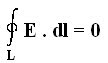
- The work done per unit charge in moving a test charge from point A to point B is the electrostatic potential difference between the two points(V AB ). V AB = V B - V A Similarly, V BA = V A – V B - Hence it’s clear that potential difference is independent of the path taken. Therefore V AB = - V BA V AB + V BA = 0 - ∫ A B (E . dl) + [ - ∫ B A (E . dl) ] = 0 - The above equation shows that the line integral of Electric field intensity (E) along a closed path is equal to zero. - In simple words, “No work is done in moving a charge along a closed path in an electrostatic field”. - Applying Stokes’ Theorem to the above Equation, we have: - If the Curl of any vector field is equal to zero , then such a vector field is called an Irrotational or Conservative Field. - Hence an electrostatic field is also called a conservative field. - The above equation is called the second Maxwell’s Equation of Electrostatics. - Since Electric pot...

Scalar Electric Potential / Electrostatic Potential (V) - Electrostatic Fields.

Image
- If a charge is placed in the vicinity of another charge (or in the field of another charge), it experiences a force. - If a field being acted on by a force is moved from one point to another, then work is either said to be done on the system or by the system. - Say a point charge Q is moved from point A to point B in an electric field E , then the work done in moving the point charge is given as:   W A→B = - ∫ A B (F . dl) = - Q ∫ A B (E . dl) where the – ve sign indicates that the work is done on the system by an external agent. - The work done per unit charge in moving a test charge from point A to point B is the electrostatic potential difference between the two points(V AB ). V AB = W A→B / Q  = - ∫ A B (E . dl)  = - ∫ Initial Final (E . dl) - If the potential difference is positive , there is a gain in potential energy in the movement, external agent performs the work against the field. - If the sign of the potential differ...