Gauss Law (Theory) & Application To A Point Charge - Field Theory.
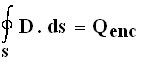
- Gauss law is one of the fundamental laws of Electrostatics. - It states that “The net electric flux emanating or coming from a close surface S is equal to the total charge contained within the volume V bounded by that surface.” We know, Therefore Ψ = Q enc Hence Gauss law also states that “The total electric flux Ψ through any closed surface is equal to the enclosed electric charge.” - Charge contained in a volume is given as: dQ = ρ v dv → Q = ∫ V ρ v dv Hence we have, Applying Divergence theorem we have, Comparing the above two equations, we have And hence ∇ . D = ρ v This equation is called the 1 st Maxwell's equation of electrostatics. - Gauss law is an easy way of finding electric field for some symmetric problems in electrostatics. - Gauss law relates the electric field at points on a closed Gaussian surface to the net charge enclosed by that surface. - One thing to remember ...