Application Of Gauss Law To A Uniformly Charged Sphere - Field Theory.
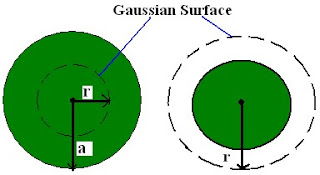
- Consider a sphere of radius “a” having a uniform volume charge density of ρ o C/m 3 . - Gaussian surface selected for a symmetric sphere charge is a sphere itself. - Here we consider two cases: A Gaussian surface with a radius r < a. A Gaussian surface with a radius r > a. CASE 1: If r < a (consider the 1st figure), the total charge enclosed by the Gaussian surface is: Electric flux is given as: Here ds is taken to be a function of θ and φ ( since the surface is a hollow sphere). Gauss law states that Ψ = Q enc Therefore, D r 4π r 2 = (4 / 3) (ρ o πr 3 ) Or D = (r / 3) ρ o a r (0 < r < a) CASE II: If r > a (consider the above figure), the total charge enclosed by the Gaussian surface is: Electric flux is given as: Gauss law states that Ψ = Q enc Therefore, ...