Posts

Showing posts with the label Electric Field In Material Space

Electric Fields In Material Space - Questions With Answers (Short Notes)

01. How Can Materials Be Classified In Terms Of Their Electrical Properties? Answer:  Materials can be classified roughly as conductors (σ >> 1, ε r = 1) and dielectrics ( σ << 1, ε r  ≥ 1 ) in terms of their electrical properties  σ  and  ε r  where  σ  is the conductivity and  ε r  is the dielectric constant or relative permittivity. A material with high conductivity ( σ >> 1) is referred to as a metal whereas one with low conductivity ( σ << 1 ) is referred to as an insulator. A material whose conductivity lies somewhere between those of metals and insulators is called a semiconductor. 02. Define Superconductor? Answer: The conductivity of metals generally increases with decrease in temperature. At temperatures near absolute zero (T = 0°K), some conductors exhibit infinite conductivity and are called superconductors. Lead and aluminum are typical examples of such metals. 03. Why...
Vector Analysis & Electrostatics - Index / Sitemap.

INDEX Vector analysis is a mathematical tool with which electromagnetic (EM) concepts are most conveniently expressed. It's important to learn its rules and techniques first applying it. VECTOR ALGEBRA: - Scalars and Vectors. - Unit Vectors. - Position and Distance Vectors. - Vector Multiplication. - Components Of a Vector. - Numericals / Solved Examples. COORDINATE SYSTEMS & TRANSFORMATION: In general, the physical quantities in ElectroMagnetics are functions of space and time. In order to describe the spatial variations of the quantities, its important to define all points uniquely in space in a suitable manner. This requires using an appropriate coordinate system. Hence its very important to understand the coordinate system first.  - Introduction To Coordinate System. - Cartesian Coordinate System / Rectangular Coordinate System (x, y, z). - Differential Analysis Of Cartesian Coordinate System. - Circular Cylindrical Coordinate System (ρ, φ, z)...

Conductors (Isolated & Non-Isolated) In Electric/Electrostatic Field.

Image
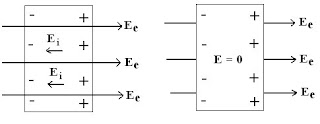
- A conductor (such as Copper, Aluminum, gold) contains electrons that are not bounded to the atom and are free to move within the material. - When an isolated conductor is placed in an external electric field E e , the negative charges ( electrons ) starts moving in the opposite direction to that of electric field. - Soon the electrons get accumulated on the surface of one side of the conductor , while the surface on the other side gets depleted of electrons and hence acquire a positive charge (+ve). - These separated negative (-ve) and positive charges (+ve) on the opposite sides of the conductor produces an internal induced electric field E i which opposes the external field E e inside the conductor. - If the conductor is a perfect conductor or a good conductor the internal electric field E i will cancel the external electric field E e . Hence we can therefore say that “A perfect conductor cannot contain an electrostatic field inside it.” - There ...