Posts

Showing posts with the label Vector Calculus

Vector Analysis & Electrostatics - Index / Sitemap.

INDEX Vector analysis is a mathematical tool with which electromagnetic (EM) concepts are most conveniently expressed. It's important to learn its rules and techniques first applying it. VECTOR ALGEBRA: - Scalars and Vectors. - Unit Vectors. - Position and Distance Vectors. - Vector Multiplication. - Components Of a Vector. - Numericals / Solved Examples. COORDINATE SYSTEMS & TRANSFORMATION: In general, the physical quantities in ElectroMagnetics are functions of space and time. In order to describe the spatial variations of the quantities, its important to define all points uniquely in space in a suitable manner. This requires using an appropriate coordinate system. Hence its very important to understand the coordinate system first.  - Introduction To Coordinate System. - Cartesian Coordinate System / Rectangular Coordinate System (x, y, z). - Differential Analysis Of Cartesian Coordinate System. - Circular Cylindrical Coordinate System (ρ, φ, z)...
Laplacian of a Scalar Field - Definition, Significance & Solved Examples.

Image
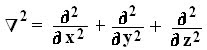
- The laplacian is a scalar operator . Hence when applied to scalar field , the result is also a scalar field. - Laplace operator is a second order differential equation defined as the divergence of the gradient of scalar field. - Laplacian of a scalar field V is written as ∇ 2 V. - Laplacian of a scalar is:             - Used in electrostatics to represent the charge associated to a given potential.             - Used in defining the Helmholtz equation of propagation of EM wave.             - Used in Laplace’s and Poisson’s equation. Laplacian of a scalar field V in Cartesian coordinate system is given as: Laplacian of a scalar field V in Cylindrical coordinate system is given as: Laplacian of a scalar field V in Spherical coordinate system is given as: Q.1 Determi...

Curl Of a Vector Field (Curl A) - Definition, Significance and Solved Examples.

Image
Circulation of a vector field A around a closed path L is defined as: Mathematically Curl of a vector A is defined as: Where the area Δ S is bounded by the curve L and the unit vector a n is the unit vector normal to the surface. - The direction of the curl is the axis of rotation , as determined by the right hand thumb rule and the magnitude of the curl is the magnitude of rotation. - From the above relation we can define Curl as the maximum circulation per unit area. - The curl of a vector field provides another vector field that indicates rotational sources of the original vector field. - Curl is a measurement of the circulation of vector field A around a particular point. - If there’s a paper boat in a whirlpool, the circulation would be the amount of force that pushed it along as it went in a circle. The more circulation , the more pushing force you have. - Consider a closed loop counter C. The circulation will be positive if a compone...

Solved Examples/Numericals - Divergence of a Vector Field.

Image
Q.1 Determine the divergence of the following vector fields and evaluate them at the specified points: a) A = yz a x + 4xy a y + y a z at point (1, -2, 3) Ans: Given A = yz a x + 4xy a y + y a z at point (1, -2, 3) Divergence of A is given as: ∇ . A = 0 + 4x + 0 = 4x At Point (1, -2, 3)  Hence, ∇ . A = 4 b) A = ρzsinφ a ρ + 3ρz 2 cosφ a φ at (5, π / 2, 1) Ans: Divergence of a vector field A in cylindrical co-ordinate system is given as: => ∇ . A = (1/ρ) 2ρz sinφ - (1/ρ) 3ρz 2 sinφ = 2zsinφ - 3z 2 sinφ =  (2 - 3z) zsinφ At point (5, π / 2, 1)        ∇ . A = (2 – 3) (1) = -1 c) A = 2r cosθ cosφ a r + r 1/2 a φ   at (1, π / 6, π / 3) Ans: Divergence of a vector field A in Spherical co-ordinate system is given as: => ∇ . A = (1/r 2 ) 6r 2 cosθ cosφ = 6 cosθ cosφ At point (1, π/6, π/3) ∇ . A= 6 cos π/6 cos π/3 = 2.598. Q. 2 Determine the flux of D = ρ 2 cos 2 ...

Divergence Of a Vector Field ( div A) - Definition, Significance & Solved Problems.

Image
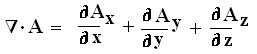
Mathematically divergence of a vector A is defined as: Where the surface S is a closed surface that completely surrounds a small volume Δ v and where ds points outward from the closed surface. - A divergence is applied to a vector as a function of position, yielding a scalar . The divergence actually measures how much the vector function is spreading out. - Divergence of a vector field A is a measure of how much a vector field converges to or diverges from a given point. In simple terms it is a measure of the outgoingness of a vector field. - Divergence of a vector field is positive if the vector diverges or spread out from a given point. If you are at a location from which the vector field tends to point away in all directions, you will definitely have a positive divergence. It means divergence is positive at a source point in the field. - Divergence of a vector field is negative if the vector field converges at that point. If the field points in...

Gradient of a Scalar T (grad T) - Definition, Significance & Solved Examples.

Image
- The gradient of a scalar field provides a vector field that states how the scalar value is changing throughout space – a change that has both a magnitude and direction. - A gradient is applied to a scalar quantity that is a function of a 3D vector field: position . The gradient measures the direction in which the scalar quantity changes the most, as well as the rate of change with respect to position. - The physical meaning of the gradient of a scalar is that it represents the steepness of the slope or line. For example, height is a scalar quantity; gradient of the height would be a vector pointing upwards. The length of the vector is proportional to the steepness of the slope. - A derivative is required that tells us how fast the function varies , if we move a little distance. - Consider a scalar function T which is a function of space coordinates x, y and z. - The projection or the component of ∇ T in the direction of a unit vector a l is ∇ T . a l and...

Del Operator - Definition & Significance - Coordinate System.

Image
- The collection of partial derivative operators is called DEL operator. Hence DEL can be viewed as the derivative in multi dimensional space. - DEL operator is defined as a vector differential operator. - A DEL operator is not a vector in itself, but when acts on a scalar function, it becomes a vector. - Del is not simply a vector ; it is a vector operator. Whereas a vector is an quantity with both a magnitude and direction, DEL does not have a precise value for either until it is allowed to operate on something. - In Cartesian coordinate system Del operator is given as: This operator is useful or significant in defining Gradient of a scalar V (∇ V) Divergence of a vector A (∇ . A) Curl of a vector A (∇ x A) Laplacian of a scalar V (∇ 2 V) DEL OPERATOR - CYLINDRICAL CO-ORDINATE SYSTEM : Unit vectors of Cartesian co-ordinate system are related to unit vectors of Cylindrical co-ordinate system as: a x = a ρ cosφ – a φ sinφ a y = a ρ sinφ + a φ...

Line, Surface And Volume Integrals - Field Theory.

Image
- The Line integral of Vector A along a path L is given as ∫ L A .dl - The line integral is the dot product of a vector with a specified curve C. - We can also say that line integral is the integral of the tangential component of vector A along the curve C. - If the path of integration is a closed path, the line integral becomes a closed line integral and is called the circulation of A around C. -  Line Integral is useful in finding the electric field intensity along a path L. - The surface integral of a vector B across a surface S is defined as ∫ s B .ds - When the surface S is closed, the surface integral becomes the net outward flux of B across S, i.e. - Surface integral is useful in finding the magnetic flux through a surface S. - The volume integral of a scalar T over a volume v is given as ∫ v T . dv SOLVED EXAMPLES/NUMERICALS: Q.1 Calculate the circulation of A = ρ cosφ a ρ + z sinφ a z around the edge L of the wedge defin...