Posts

Showing posts with the label Differential length

Differential analysis - Spherical Co-ordinate System - Field Theory.
Image
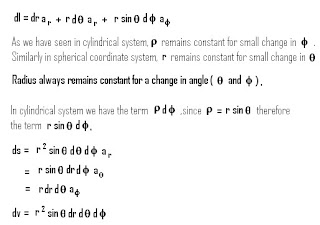
Always remember that for a small change in angle the radius remains constant. Radius of a cylinder (ρ) is constant for a small change in φ . Similarly the radius of a sphere (r) is constant for a small change in θ. Therefore ρ always associates dφ , and r always associates dθ. Differential Length (dl) : - dl = dra r + r dθa θ + ρ dφ a φ We know that ρ = rsinθ Therefore dl = dra r + r dθa θ + r sinθdφ a φ Differential length for a surface is given as: - dl = dra r + r dθa θ ---( For r - θ plane or φ constant plane) - dl = r dθa θ + r sinθdφa φ ---( For θ - φ plane or r constant plane) - dl = dra r + r sinθdφ a φ ---( For r - φ plane or θ constant plane) Differential length for a line parallel to r, θ and φ axis are respectively given as: - dl = dra r ---(For a line parallel to r axis) - dl = r dθa θ ---( For a line parallel to θ axis) ∫ dl = ∫ o π rdθ = r (π - 0) = π r This answer describes the circumference of a semi circle. ...
Differential Analysis - Cylindrical Coordinate System - Field Theory.

Image
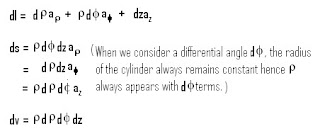
Differential Length(dl):   In General the differential length is given as dl = dρ a ρ + ρdφ a φ + dz a z Differential Length for a surface is given as: - dl = dρ a ρ + ρdφ a φ ---(For ρ-φ Plane or Z constant Plane) - dl = ρdΦ a φ + dz a z ---(For φ-z Plane or ρ Constant Plane) - dl = dρ a ρ + dz a z ---(For ρ-z Plane or φ Constant Plane) Differential length for a line parallel to ρ, φ and z axis are respectively given as: - dl = dρ a ρ ---(For a line parallel to ρ axis) - dl = ρdφ a φ ---(For a line parallel to φ axis) ∫ dl = ∫ o 2π ρdφ = ρ( 2π - 1) = 2πρ This resembles the circumference of a circle. Hence if φ varies with ρ and z constant, then the length is the circumference of the circle. dl = dza z ---(For a line parallel to z axis) Differential Surface (ds): - ds = ρdρ dφ a z   This surface describes a circular disc. Always remember- To define a circular disk we need two parameter one distance measure and one angular mea...

Cartesian / Rectangular Coordinate System (X, Y, Z) - Field Theory.

Image
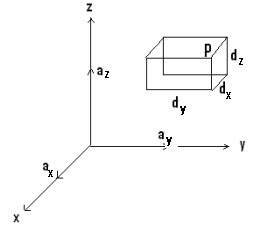
A Vector in Cartesian system is represented as (A x , A y , A z ) Or A = A x a x + A y a y + A z a z Where a x , a y and a z are the unit vectors in x, y, z direction respectively. Range of the variables: It defines the minimum and the maximum value that x, y and z can have in Cartesian system. -∞ ≤ x,y,z ≤ ∞ Differential Displacement / Differential Length (dl): It is given as dl = dxa x + dya y + dza z Differential length for a surface is given as: dl = dxa x + dya y --- ( For XY Plane or Z Constant Plane). dl = dya y + dza z , ---( For YZ Plane or X Constant Plane). dl = dxa x + dza z ---( For XZ Plane or Y Constant Plane). Differential length for a line parallel to x, y and z axis are respectively given as: dl = dxa x ---( For a line parallel to x-axis). dl = dya y ---( For a line Parallel to y-axis). dl = dza z , ---( For a line parallel to z-axis). If there is a wire of length L in z-axis, then the differential length is given as...