Application Of Gauss Law To An Infinite Line & Sheet Charge - Field Theory.
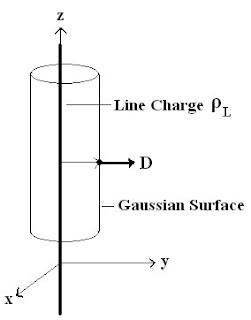
- Consider an infinite line charge carrying a charge per unit length of ρ L along the z axis. - Gaussian surface selected for a symmetric line charge is a hollow cylinder of radius ρ and length l as shown in the figure - A cylinder has basically three surfaces: top, bottom and the curved cylindrical surface. From the diagram its clear that - Electric flux density (D) is parallel to the top and bottom Gaussian surface. - Electric flux density (D) is normal to the curved cylindrical Gaussian surface. - Differential surface (ds) is always normal to a surface. D and ds are normal to each other for the top and bottom Gaussian surface. Hence ∫ (D . ds) = 0 Hence it’s clear that D and ds are parallel to each other only for the curvilinear Gaussian surface. - Since the Gaussian surface is a hollow cylinder , hence the variable terms are φ and z. Thus the differential surface for a hollow cylinder is given as: ds = ∫ (φ=0) 2π ∫ 0 l (ρ dφ...