Field Theory - ELECTROMAGNETIC THEORY MADE EASY........

INDEX


VECTOR ALGEBRA:


- Scalars and Vectors.

- Unit Vectors.

- Position and Distance Vectors.

- Vector Multiplication.

- Components Of a Vector.

- Numericals / Solved Examples.


COORDINATE SYSTEMS & TRANSFORMATION:


- Introduction To Coordinate System.

- Cartesian Coordinate System / Rectangular Coordinate System (x, y, z).

- Differential Analysis Of Cartesian Coordinate System.

- Circular Cylindrical Coordinate System (ρ, φ, z).

- Differential Analysis Of Cylindrical Coordinate System.

- Spherical Coordinate System ( r, θ , φ).

- Differential Analysis Of Spherical Coordinate System.

- Numericals / Solved Examples - Page 1.

- Numericals / Solved Examples - Page 2.


VECTOR CALCULUS:


- Line , Surface and Volume Intergral.

- Del Operator - Definition and Significance.

- Gradient Of a Scalar (∇ V).

- Numericals / Solved Examples - Gradient Of a Scalar.

- Divergence Of a Vector ( ∇ . A ).

- Numericals / Solved Examples - Divergence Of a Vector.

- Curl Of a Vector ( ∇ x A).

- Laplacian Of a Scalar ( ∇2 V).

ELECTROSTATIC FIELD:

- Introduction To Electrostatics.

- Coulomb's law.

- Electric Field Intensity (E).

- Electric Lines Of Forces /Streamlines / Electric Flux (ψ) .

- Electric Flux Density (D).

- Electric Field Intensity Due To a Finite and Infinite Line Charge.

- Electric Field Intensity Due To a Infinite Sheet Charge.

- Electric Field Intensity Due To a Circular Ring Charge.

- Electric Field Intensity Due To a Circular Disk Charge.

- Numericals / Solved Examples - Electric Force and Field Intensity.

- Numericals / Solved Examples - Electric Field Intensity - Line, Surface and Mixed Charge Configuration.


- Gauss's Law - Theory.

- Gauss's Law - Application To a Point charge.

- Gauss's Law - Application To An Infinite Line Charge.

- Gauss's Law - Application To An Infinite Sheet Charge.

- Gauss's Law - Application To a Uniformly Charged Sphere.

- Numericals / Solved Examples - Gauss's Law.

- Scalar Electric Potential / Electrostatic Potential (V).

- Relationship Between Electric Field Intensity (E) and Electrostatic Potential (V).

- Electric Potential Due To a Circular Disk.

- Electric Dipole.

- Numericals / Solved Examples - Electric Potential and Electric Dipole.

- Energy Density In Electrostatic Field / Work Done To Assemble Charges.

- Numericals / Solved Examples - Electrostatic Energy and Energy Density.


ELECTRIC FIELD IN MATERIAL SPACE:

- Properties Of Materials.

- Current (I) and Current Density (J).

- Conduction and Convection Current Density.

- Isolated Conductor Under The Influence Of An Applied Electric Field (E).

- Conductor Wired To a Source Of Electromotive Force.


Your suggestions and comments are welcome in this section. If you want to share something or if you have some stuff of your own, please do post them in the comments section.

Field Theory - Laplacian of a Scalar - Defination, Significance and Solved Examples...

- The laplacian is a scalar operator. Hence when applied to scalar field, the result is also a scalar field.


- Laplace operator is a second order differential equation defined as the divergence of the gradient of scalar field.

- Laplacian of a scalar field V is written as ∇2 V.

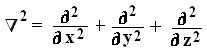
- Laplacian of a scalar is:
            - Used in electrostatics to represent the charge associated to a given potential
            - Used in defining the Helmholtz equation of propagation of EM wave.
            - Used in Laplace’s and Poisson’s equation.


Laplacian of a scalar field V in Cartesian coordinate system is given as:


Laplacian of a scalar field V in Cylindrical coordinate system is given as:


Laplacian of a scalar field V in Spherical coordinate system is given as:


Q.1 Determine the Laplacian of the scalar fields:
a) V = x2y + xyz
Ans:


=> ∇2 V = [(d / dx) ( 2xy + yz)] +[ (d / dy) ( x2 + xz)] + [(d / dz) (xy)] = 2y


b) V = ρz sinφ + z2cos2 φ + ρ2
Ans:


= (1 / ρ) (z sinφ + 4ρ) – (1 / ρ2) (2ρ sinφ + 2z2 cos 2φ) + 2 cos2 φ

= 4 + 2 cos2 φ - (1 / ρ2) 2z2 cos 2φ

- ... Back To Index.

Your suggestions and comments are welcome in this section. If you want to share something or if you have some stuff of your own, please do post them in the comments section.

Field Theory - Curl Of a Vector Field ( curl A) - Defination, Significance and Solved Examples...


Circulation of a vector field A
around a closed path L is defined as:


Mathematically Curl of a vector A is defined as:


Where the area Δ S is bounded by the curve L and the unit vector an is the unit vector normal to the surface.

- The direction of the curl is the axis of rotation, as determined by the right hand thumb rule and the magnitude of the curl is the magnitude of rotation.

- From the above relation we can define Curl as the maximum circulation per unit area.

- The curl of a vector field provides another vector field that indicates rotational sources of the original vector field.


- Curl is a measurement of the circulation of vector field A around a particular point.

- If there’s a paper boat in a whirlpool, the circulation would be the amount of force that pushed it along as it went in a circle. The more circulation, the more pushing force you have.


- Consider a closed loop counter C. The circulation will be positive if a component of vector field A is pointing in the direction dl at every point on counter C. Hence if the circulation is positive then obviously the curl of a vector A will also be positive.


- Similarly if a component of vector field A points in the opposite direction (- dl) at every point of the counter, then the circulation and thus the curl will be negative.


- If the curl of a vector field A is zero, then the vector field A is said to be irrotational or potential (if ∇ x A =0). In such cases, the circulation of A around a closed path is zero; it implies that the line integral of A is independent of the chosen path. Hence an irrotational field is also known as a conservative field. 

Curl of a vector A in Cartesian Coordinate system is given as:


The above is the determinant form of the formula for curl. The first line is made up of unit vectors, the second of scalar operators, and the third of scalar functions, so this is not a determinant in the strict mathematical sense.


Curl of vector A in Cylindrical coordinate system is given as:


Curl of vector A in Spherical coordinate system is given as:


STOKES THEOREM:


It states that the circulation of a vector field A around a closed path L is equal to the surface integral of the curl of A over the open surface S bounded by L.


The divergence theorem relates a closed surface integral to an open volume integral, the Stokes theorem relates a closed line integral to an open surface integral.


Q.1 Determine the curl of each of the vector field:
a) A = yz ax + 4xy ay + y az
Ans:


=> ∇ x A = ax (1 – 0) + ay (y – 0) +az (4y – z)

= ax + y ay + (4y – z) az

b) A = ρz sinφ aρ + 3ρz2cosφ aφ
Ans:


=> ∇ x A = aρ ( 0 - 6ρzcosφ) + aφ (ρsinφ – 0)
+ az (6ρz2 cosφ – ρzcosφ)

= - 6 ρzcosφ aρ + ρsinφ aφ + (1 / ρ)( 6ρz2 cosφ – ρzcosφ) az

= - 6 ρzcosφ aρ + ρsinφ aφ + (6z – 1) zcosφ az

Q.2 Show that A = (y + z cos xz) ax + x ay + xcosxz az is conservative, without computing any integrals?
Ans:
If A is conservative, then curl of vector A should be equal to zero.


=>∇ x A = 0.
Hence A is a conservative field.

- ... Back To Index.

NEXT TOPIC:

- Laplacian Of a Scalar ( ∇2 V).

Your suggestions and comments are welcome in this section. If you want to share something or if you have some stuff of your own, please do post them in the comments section.

Field Theory - Numericals / Solved Examples - Divergence of a Vector...


Q.1 Determine the divergence of the following vector fields and evaluate them at the specified points:

a) A = yz ax + 4xy ay + y az at point (1, -2, 3)
Ans:

Given A = yz ax + 4xy ay + y az at point (1, -2, 3)

Divergence of A is given as:


∇ . A = 0 + 4x + 0 = 4x
At Point (1, -2, 3)  Hence, ∇ . A = 4

b) A = ρzsinφ aρ + 3ρz2 cosφ aφ at (5, π / 2, 1)
Ans:

Divergence of a vector field A in cylindrical co-ordinate system is given as:


=> ∇ . A = (1/ρ) 2ρz sinφ - (1/ρ) 3ρz2 sinφ

= 2zsinφ - 3z2 sinφ =  (2 - 3z) zsinφ

At point (5, π / 2, 1)       ∇ . A = (2 – 3) (1) = -1

c) A = 2r cosθ cosφ ar + r1/2 aφ   at (1, π / 6, π / 3)
Ans:

Divergence of a vector field A in Spherical co-ordinate system is given as:


=> ∇ . A = (1/r2) 6r2 cosθ cosφ = 6 cosθ cosφ

At point (1, π/6, π/3)

∇ . A= 6 cos π/6 cos π/3 = 2.598.


Q. 2 Determine the flux of D = ρ2 cos2φ aρ + zsin φ aφ over the closed surface of the cylinder, 0 < z < 1, ρ =4. Verify the divergence theorem for this case.
Ans:


We know a closed cylinder has three surface - top(t), bottom(b) and curved surface(s).

Ψ = Ψt + Ψb + Ψs

Ψt = Ψb = 0, since D has no z component.

It means,
Ψs = ∫ ∫ ρ2 cos2φ (ρ dφ dz)
= ρ30cos2φ dφ ∫ 01dz
= (4)3 (π) (1) = 64 π

Therefore,

Ψ = Ψt + Ψb + Ψs = 64 π

By the divergence theorem,


Divergence of D is given as:


∇ . A = 3ρ cos2φ - (1/ρ) cosφ


= ∫ ∫ ∫(3ρ cos2φ - (1/ρ) cosφ)   ρdρ dφ dz

= 3 ∫04 ρ2dρ  ∫0 cos2φ dφ  ∫01dz  +  ∫04dρ  ∫0 cosφdφ  ∫01 dz

= 3 (43 /3 ) (π ) (1) = 64π

- ... Back To Index.

NEXT TOPIC:

- Curl Of a Vector ( ∇ x A).

- Laplacian Of a Scalar ( ∇2 V).


Your suggestions and comments are welcome in this section. If you want to share something or if you have some stuff of your own, please do post them in the comments section.

Field Theory - Divergence Of a Vector Field ( div A) - Defination and Significance...

Mathematically divergence of a vector A is defined as:


Where the surface S is a closed surface that completely surrounds a small volume Δ v and where ds points outward from the closed surface.

- A divergence is applied to a vector as a function of position, yielding a scalar. The divergence actually measures how much the vector function is spreading out.

- Divergence of a vector field A is a measure of how much a vector field converges to or diverges from a given point. In simple terms it is a measure of the outgoingness of a vector field.


- Divergence of a vector field is positive if the vector diverges or spread out from a given point. If you are at a location from which the vector field tends to point away in all directions, you will definitely have a positive divergence. It means divergence is positive at a source point in the field.

- Divergence of a vector field is negative if the vector field converges at that point. If the field points inward toward a point, the divergence in and near that point is negative. It means divergence is negative at sink point in the field.


- Hence a nonzero divergence at some point means there must be a source or sink at that position.

- If just as much of the vector field points in as out, the divergence will be approximately zero.

- A vector field with constant zero divergence is called solenoidal or divergenceless or incompressible (∇ . A = 0). In such cases no net flow can occur across any closed surface.

- Divergence of a vector field results in a scalar field that represents the sources of the vector field.


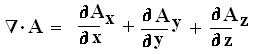
- Divergence of a vector field A in Cartesian coordinate system is given as:


- Divergence of a vector field A in Cylindrical coordinate system is given as:


- Divergence of a vector field A in Spherical coordinate system is given as:


DIVERGENCE THEOREM:

- It states that the net outward flux of a vector field A through a closed surface S is equal to the volume integral of the divergence of the field A inside the surface.


- It also states that the sum of all sources minus the sum of all sinks gives the net flow out of a region.


- ... Back To Index.

NEXT TOPIC:

- Numericals / Solved Examples - Divergence Of a Vector.

- Curl Of a Vector ( ∇ x A).


Your suggestions and comments are welcome in this section. If you want to share something or if you have some stuff of your own, please do post them in the comments section.

Field Theory - Numericals / Solved Examples - Gradient of a scalar

Q. 1 Find the gradient of these scalar fields:
a) U = 4xz2 + 3yz
b) H = r2cosθ cosφ
Ans:
a)


=>∇ U = 4z2 ax + 3z ay + (8xz +3y) az

b)


=>∇ H = 2r cosθ cosφ ar + r sinθ cosφ aθ + rcosθ sinφ aφ 

Q.2 If V(x, y, z) = 3x2y –y2z2, find ∇ V and |∇ V| at the point (1, 2, -1).
Ans:


∇ V = 6xy ax + (3x2 – 2yz2) ay + (-2y2z) az

At the point (1, 2, -1)

∇ V = 6(1)(2) ax + [3(12) – 2(2)(-1)2] ay – 2(2)2 (-1) az
=>∇ V = 12ax - ay + 8az

|∇ V| (1, 2, -1) = |12ax - ay + 8az | = (209)1/2

Q.3 Given φ = xy +yz +xz, find gradient φ at point (1, 2, 3) and thedirectional derivative of φ
Ans:
∇ φ = (y + z)ax + (x + z)ay + (y + z)az

At point (1, 2, 3)

∇ φ = 5ax + 4ay + 3az

The directional derivative is given as:

dφ/dl = ∇ φ . al
= (5, 4, 3) . [(3, 4, 4) – (1, 2, 3)] / 3
= [(5, 4, 3) . (2, 2, 1)] / 3 = 7


Q.4 Find V(x, y, z) if grad V = (y2 – 2xyz3)ax + (3 + 2xy – x2z3)ay + (4z3 – 3x2yz2)az and V(0, 0, 0) = -2.
Ans:

∂V / ∂x = y2 -2xyz3

∂V / ∂y = 3 + 2xy – x2z3

∂V / ∂y = 4z3 – 3x2yz2

V = ∫( y2 – 2xyz3) dx = xy2 – x2yz3 + f(y, z)

V = ∫( 3 + 2xy – x2z3) dy = 3y + xy2 – x2yz3 + g(x, z)

V = ∫( 4z3 – 3x2yz2) dz = z4 – x2yz3 + h(x, y)

Comparing the above 3 equations, we have
f (x, y) = 3y + z4 + c

Hence,

V = xy2 – x2yz3 + 3y + z4 + c

Since V(0, 0, 0) = -2

V = xy2 – x2yz3 + 3y + z4 – 2


Q.5 Find the unit normal vector of the surface x2 + y2 + z2 = 14 at (-1, 3, 2) ?
Ans:
Here V (x, y, z) = x2 + y2 + z2

∇ V = 2x ax + 2y ay + 2z az

At point (-1, 3, 2)

∇ V = -2ax + 6ay + 4az

|∇ V| = 2(14)1/2

Unit normal vector
an = ∇ V / | ∇ V |
= - ax + 3ay + 2az / (14)1/2


Q.6 The temperature in an auditorium is given by T = x2 + y2 – z. A mosquito located at (1, 1, 2) in the auditorium desires to fly in such a direction that it will get warm as soon as possible. In what direction must it fly?


Ans:


∇ T = 2xax + 2yay - az

At point (1, 1, 2)

∇ T = 2ax + 2ay - az

The mosquito should move in the direction of 2ax + 2ay - az.

- ... Back To Index.

NEXT TOPIC:

- Divergence Of a Vector ( ∇ . A ).

- Numericals / Solved Examples - Divergence Of a Vector.


Your suggestions and comments are welcome in this section. If you want to share something or if you have some stuff of your own, please do post them in the comments section.

Field Theory - Gradient of a Scalar T (grad T) - Defination and Significance....

- The gradient of a scalar field provides a vector field that states how the scalar value is changing throughout space – a change that has both a magnitude and direction.

- A gradient is applied to a scalar quantity that is a function of a 3D vector field: position. The gradient measures the direction in which the scalar quantity changes the most, as well as the rate of change with respect to position.

- The physical meaning of the gradient of a scalar is that it represents the steepness of the slope or line. For example, height is a scalar quantity; gradient of the height would be a vector pointing upwards. The length of the vector is proportional to the steepness of the slope.


- A derivative is required that tells us how fast the function varies, if we move a little distance.

- Consider a scalar function T which is a function of space coordinates x, y and z.


- The projection or the component of ∇ T in the direction of a unit vector al is ∇ T . al and is called the DIRECTIONAL DERIVATIVE of T along unit vector. Hence dT/dl is the directional derivative of T.

- Hence we also say that, the gradient of a scalar field indicates the direction of greatest change (that is largest derivative) as well as the magnitude of that change, at every point in space.


PROPERTIES OF GRADIENT OF A SCALAR FIELD T:

- If A =∇ T, T is said to be the scalar potential of A.

- The magnitude of ∇ T equals the maximum rate of change in T per unit distance.

- ∇T points in the direction of the maximum rate of change in V.

- ∇T at any point is perpendicular to the constant T surface that passes through that point.


Gradient of a scalar T for Cartesian coordinate system is given as:


Gradient of a scalar T for Cylindrical coordinate system is given as:


Gradient of a scalar T in Spherical coordinate system is given as:


- ... Back To Index.

NEXT TOPIC:

- Numericals / Solved Examples - Gradient Of a Scalar.

- Divergence Of a Vector ( ∇ . A ).


Your suggestions and comments are welcome in this section. If you want to share something or if you have some stuff of your own, please do post them in the comments section.

Field Theory - Del Operator - Defination and Significance...

- The collection of partial derivative operators is called DEL operator. Hence DEL can be viewed as the derivative in multi dimensional space.

- DEL operator is defined as a vector differential operator.

- A DEL operator is not a vector in itself, but when acts on a scalar function, it becomes a vector.


- Del is not simply a vector; it is a vector operator. Whereas a vector is an quantity with both a magnitude and direction, DEL does not have a precise value for either until it is allowed to operate on something.

- In Cartesian coordinate system Del operator is given as:


This operator is useful in defining
- Gradient of a scalar V (∇ V)
- Divergence of a vector A (∇ . A)
- Curl of a vector A (∇ x A)
- Laplacian of a scalar V (∇2 V)


DEL OPERATOR - CYLINDRICAL CO-ORDINATE SYSTEM:

Unit vectors of Cartesian co-ordinate system are related to unit vectors of Cylindrical co-ordinate system as:

ax = aρ cosφ – aφ sinφ

ay = aρ sinφ + aφ cosφ

az =az

The differential part of x, y in terms of ρ and φ is given as:


Since the del operator is given as:


Substituting the values, we get


DEL OPERATOR - SPHERICAL CO-ORDINATE SYSTEM:

Unit vectors of Spherical co-ordinate system are related to unit vectors of Cartesian co-ordinate system as:

ax = sinθ cosφ ar + cosθ cosφ aθ – sinφ aφ

ay = sinθ sinφ ar + cosθ sinφ aθ + cosφ aφ

az = cosθ ar - sinθ aθ

The differential part of x, y, z in terms of r, θ and φ as:


Substituting the values, we get


- ... Back To Index.

NEXT TOPIC:

- Gradient Of a Scalar (∇ V).

- Numericals / Solved Examples - Gradient Of a Scalar.


Your suggestions and comments are welcome in this section. If you want to share something or if you have some stuff of your own, please do post them in the comments section.

Field Theory - Line, Surface and Volume Integral...

- The Line integral of Vector A along a path L is given as

L A .dl

- The line integral is the dot product of a vector with a specified curve C.

- We can also say that line integral is the integral of the tangential component of vector A along the curve C.

- If the path of integration is a closed path, the line integral becomes a closed line integral and is called the circulation of A around C.


Line Integral is useful in finding the electric field intensity along a path L.

- The surface integral of a vector B across a surface S is defined as

s B .ds

- When the surface S is closed, the surface integral becomes the net outward flux of B across S, i.e.


- Surface integral is useful in finding the magnetic flux through a surface S.

- The volume integral of a scalar T over a volume v is given as

v T . dv


Q.1 Calculate the circulation of A = ρ cosφ aρ+ z sinφ az around the edge L of the wedge defined by 0 < ρ < 2, 0 < φ < 60o, z = 0 as shown.


A = ρcosφ aρ+z sinφ az


1 A .dl = ∫02 (ρcosφ aρ+zsinφ az) dρaρ = ρ2 cosφ / 2 = 4 / 2 = 2 (since φ = 0o)

2 A .dl = ∫0π/3 (ρcosφ aρ + zsinφ az) ρdφaφ = 0

3 A .dl = ∫20(ρcosφ aρ+zsinφ az) dρaρ = - 4 cosφ / 2

= -1 (since φ = 60o)


Q.2 Given that H = x2 ax + y2 ay, evaluate ∫L H .dl where L is along the curve y =x2 from (0, 0) to (1, 1).
Ans:
L H .dl = ∫( x2 ax + y2 ay ) . (dx ax + dy ay + dz az)
= ∫( x2 dx+ y2 dy )

But on L, y = x2 hence dy = 2x dx

Therefore
L H .dl = ∫01[x2 dx+ x4 (2xdx) ] = ∫01( x2 dx+ 2x5 dx )

= | x3/3 |01 + 2 | x6 /6 |01 = 0.667


Q.3 Given that ρs = x2 + xy, calculate ∫s ρsds over the region y ≤ x2, 0< x< 1.
Ans:

sρsds = ∫ ∫ x2 dxdy + ∫ ∫ xy dx dy

= ∫01x2 dx ∫dy +01x dx ∫ydy

= ∫01x2 dx | y | +01x dx | y2 / 2 |

= ∫01x4 dx +01 ( x5 / 2) dx = 1/5 + 1/12 = 0.2833


- ... Back To Index.

NEXT TOPIC:

- Del Operator - Definition and Significance.

- Gradient Of a Scalar (∇ V).


Your suggestions and comments are welcome in this section. If you want to share something or if you have some stuff of your own, please do post them in the comments section.

Field Theory - Numericals On Vector Algebra...


Q.1. Given vectors A = ax + 3az and B = 5ax + 2ay -6az, determine


a) |A+B|
b) 5A – B
c) Component of A along ay.
d) Unit vector parallel to 3A + B.

Ans:

a) A + B = ax +3az +5ax +2ay - 6az = 6ax + 2ay – 3az.

|A + B| = (62 + 22 + 32)1/2 = 7.


b) 5A – B = 5(ax + 3az) – 5ax – 2ay + 6az = -2ay + 21az.


c) Component of A along ax, ay and az are 1, 0 and 3 respectively.


d) 3A + B = 3ax + 9az + 5ax + 2ay -6az = 8ax + 2ay +3az


a3A + B = 3A + B/ |3A + B| = (8ax + 2ay + 3az)/ (77)1/2


Q.2 Given Points P (1, -3, 5), Q (2, 4, 6) and R (0, 3, 8) find
a) Position vectors of P and R.
b) Distance vector rQR.
c) Distance between Q and R.

Ans:

a) rp = ax – 3ay + 5az.
rR = 3ay +8az.


b) rQR = rR -rQ
= 3ay +8az – (2ax + 4ay + 6az)
= - 2ax – ay + 2az.


c) |rQR| = (22 + 12 + 22)1/2 = 3.


Q. 3 Find the unit vector along the line joining point (2, 4, 4) to point (-3, 2, 2)?

Ans:

Ā = (-3, 2, 2) – (2, 4, 4)
= (-5, -2, -2)


= - 0.87ax - 0.35ay - 0.35az


Q. 4 Given that A = 3ax + 5ay – 7az and B = ax – 2ay + az ; find

a) | 2B + 0.4A |
b) A.B - | B |2
c) A x B
 Ans:

a) 2B + 0.4A
= 2ax – 4ay +2az + 0.4 (3ax + 5ay – 7az)
= 3.2ax + 6ay - 0.8az

| 2B + 0.4A | = (3.22 + 62 + 0.82)1/2 = 6.846


b) A.B - | B |2
= (3ax + 5ay -7az) . (ax -2ay + az) – (12 + 22 +12)1/2
= - 14 – (6)1/2
= - 16.4494


c) A x B


Q.5 Given Vectors T = 2ax – 6ay + 3az and S = ax + 2ay +az; find

a) the scalar projection of T on S.
b) the vector projection of S on T.
c) the smaller angle between T and S.
Ans:

a)


b)


= -0.286 ax + 0.857ay – 0.43az


c)


Sin θTS = 0.9129 => θTS = 65.91o


Q.6 Let E = 3ay + 4az and F = 4ax – 10ay + 5az

a) Find the component of E along F.
b) Determine a Unit vector perpendicular to both E and F.
Ans:

a)


= - 0.28ax +0.71ay - 0.35az

b)


= ± (0.94, 0.27, -0.21)


Q.7 E and F are vector fields given by E = 2xax + ay +yzaz. and
F = xyax – y2ay +xyzaz. Determine:

a) | E| at (1, 2, 3)
b) Component of E along F at (1, 2, 3)
c) A vector perpendicular to both E and F at (0,1, -3) whose magnitude is unity?
Ans:


a) At (1, 2, 3), E = (2, 1, 6)


b) At (1, 2, 3),  F = (2, -4, 6)


= 1.29 ax – 2.57 ay + 3.86 az


c) At (0, 1, -3), E = (0, 1, -3) and F = (0, -1, 0)


- ... Back To Index.

NEXT TOPIC:

- Line , Surface and Volume Intergral.

- Del Operator - Definition and Significance.


Your suggestions and comments are welcome in this section. If you want to share something or if you have some stuff of your own, please do post them in the comments section.

Google Search - Blog