Posts

Vector Analysis & Electrostatics - Index / Sitemap.

INDEX Vector analysis is a mathematical tool with which electromagnetic (EM) concepts are most conveniently expressed. It's important to learn its rules and techniques first applying it. VECTOR ALGEBRA: - Scalars and Vectors. - Unit Vectors. - Position and Distance Vectors. - Vector Multiplication. - Components Of a Vector. - Numericals / Solved Examples. COORDINATE SYSTEMS & TRANSFORMATION: In general, the physical quantities in ElectroMagnetics are functions of space and time. In order to describe the spatial variations of the quantities, its important to define all points uniquely in space in a suitable manner. This requires using an appropriate coordinate system. Hence its very important to understand the coordinate system first.  - Introduction To Coordinate System. - Cartesian Coordinate System / Rectangular Coordinate System (x, y, z). - Differential Analysis Of Cartesian Coordinate System. - Circular Cylindrical Coordinate System (ρ, φ, z)...
Transmission Lines - Solved Numericals / Problems - 2.

Image
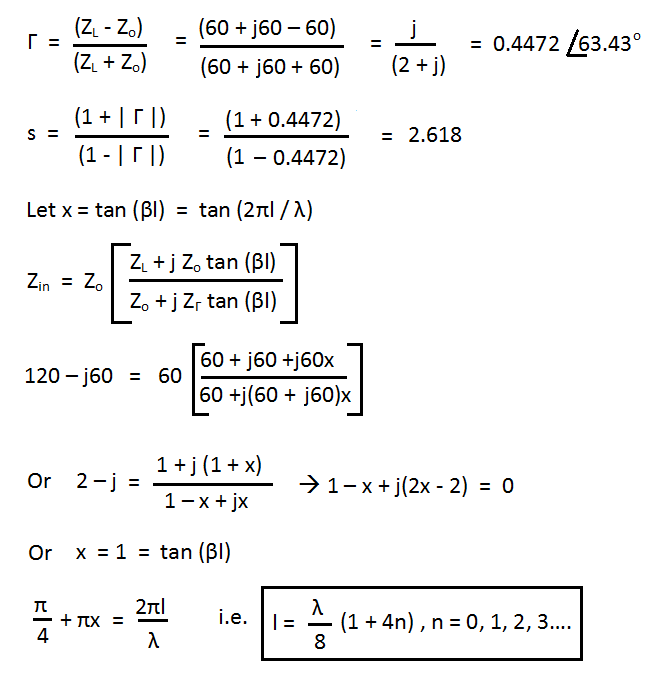
Q.4) A 70 Ω lossless line has s = 1.6 and θ Γ = 300 o . If the line is 0.6λ long, obtain (a) Γ, Z L , Z in (b) The distance of the first minimum voltage from the load Answer: a) Using the smith chart, locate S at s = 1.6. Draw a circle of radius OS. Locate P where θ Γ = 300 o . At P, | Γ | = OP / OQ = 2.1 cm / 9.2 cm = 0.228 Γ = 0.228 ∠300 o Also at P, Z L = 1.15 – j0.48, Z L = Z o  Z L = 70 (1.15 – j0.48) = 80.5 – j33.6 Ω l = 0.6 λ = 0.6 x 720 o = 432 o = 360 o + 72 o From P, move 432 o to R. At R, Z in = 0.68 – j0.25 Z in = Z o  Z in = 70 (0.68 – j0.25) = 47.6 – j17.5 Ω b) The maximum voltage (the only one) occurs at θ Γ = 180 o ; its distance from the load is      (180 – 60) λ / 720  =   λ / 6  =   0.1667 Ω Q.5) A lossless 60 Ω line is terminated by a 60 + j60 Ω load. (a) Find Γ and s. If Z in = 120 - j60 Ω, how far (in terms of wavelengths) is the load from the generat...

Solved Exercise/Numericals - Transmission Lines - 1.

Image
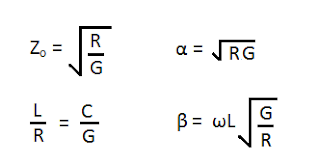
Q.1) A transmission line operating at 500 MHz has Z o = 80Ω, α = 0.04Np/m, β = 1.5 rad/m. Find the line parameters R, L, G and C. Answer: Since Z o is real & α ǂ 0, this is a distortionless line. R o = α Z o = 0.04 x 80 = 3.2 Ω / m G = α / Z o = 0.04 / 80 = 5 x 10⁻⁴ Ω / m L = β Z o / ω = 1.5 x 80 / (2 π x 5 x 108 ) = 38.2 nH / m C = L G / R = 38.2 x 10-9 x 5 x 10-4 / 3.2 = 5.97 pF / m Q.2) A telephone line R = 30 Ω /km, L = 100 mH/km, G = 0 , and C = 20 µF/km. At f = 1 kHz, obtain: a) The characteristics impedance of the line. b) The propagation constant. c) The phase velocity. Answer: Q.3) A 40 m long transmission line has V g = 15 ∠0 o V rms , Z o = 30 + j60 Ω, and V L = 5 ∠-48 o V rms . If the line is matched to the load, calculate: a) The input impedance Z in b) The sending end current I in and voltage V in c) The propagation constant γ Answer: a) Z g  =  Z 1  --> Z in ...

SOLVED Numerical's - Antenna Theory - Page 7.

Image
19) At the far field, an antenna produces Calculate the directive gain and the directivity of the antenna? SOLUTION: 20) For a thin dipole λ/16 long, find the a) Directive gain b) Directivity c) Effective area d) Radiation resistance SOLUTION: a) On substituting we get, G φ = 1.5 sin 2 θ b) Directivity , D = G φ, max = 1.5 c) Effective Area , A e = (λ 2 / 4π) G φ = (1.5 λ 2 sin 2 θ) / 4π d) Radiation Resistance R rad

SOLVED Numerical's - Antenna Theory - Page 6.

Image
16) Sketch the normalized E-field and H-field patterns for a. A half-wave dipole b. A quarter-wave monopole. SOLUTION: a) b) The same as for λ/2 dipole except that the fields are zero for θ > π/2 as shown: 17) In free space, an antenna has a far zone field given by Determine the radiated power? SOLUTION: 18) At the far field, the electric field produced by antenna is Sketch the vertical pattern of the antenna. Your plot should include as many points as possible. SOLUTION:        f(θ) = | cosθ cosφ |             For the vertical pattern, φ = 0 which means,                        f(θ) = | cosθ | which is sketched below

SOLVED Numerical's - Antenna Theory - Page 5.

Image
13) A 1-m-long car radio antenna operates in the AM frequency of 1.5 MHz. How much current is required to transmit 4 W of power? SOLUTION: This is a monopole antenna λ = c / f = (3 x 10⁸) / (1.5 x 10⁶) = 200 m In this case, it’s pretty clear that l << λ 14) An antenna located on the surface of a flat earth transmits an average power of 200 kW. Assuming that all the power is radiated uniformly over the surface of a hemisphere with the antenna at the center, calculate (a) The time-average Poynting vector at 50 km, and (b) The maximum electric field at that location. SOLUTION: a)      P rad = ∫ P rad . ∂s = P ave . 2πr 2 (hemisphere)      P ave = P rad / 2πr 2 = (200 x 10 3 ) / (2π 50 x 10 6 ) 2             =12.73 µW / m 2                                              P av...

SOLVED Numerical's - Antenna Theory - Page 4.

Image
9) A Hertzian dipole at the origin in free space has dl = 20 cm and I = 10 cos2π10 7 t A, find |E θs | at the distant point (100, 0, 0). SOLUTION: λ = c / f = ( 3 x 10⁸ ) / (107) = 30 m At (100, 0, 0), r = 100 m & θ = π / 2 10) A 2-A source operating at 300 MHz feeds a Hertzian dipole of length 5 mm situated at the origin. Find E s and H s at (10, 30°, 90°). SOLUTION:                    λ = c / f = (3 x 10⁸) / (3 x 10⁸) = 1m                    β = 2π / λ = 2π                   At r = 10, θ = 30 o , φ = 90 o                    λ = 120π = 377 m                    E θs = η H φs = 94.25 mV/m 11) An antenna can be modelled as an electric dipole of length 5 m at 3 MHz. Find the radiation resistance of...
