Posts

Vector Multiplication - Dot & Cross Product - Field Theory.

Image
Vector Multiplication: When two vectors are multiplied the result is either a scalar or a vector depending on how they are multiplied. The two important types of vector multiplication are: Dot Product/Scalar Product (A.B) Cross product (A x B) DOT PRODUCT (A . B): - Dot product of two vectors A and B is given as: A . B = |A| |B| cosθ AB Where θ AB is the angle formed between A and B. Also θ ranges from 0 to π i.e. 0 ≤ θ AB ≤ π - The result of A.B is a scalar , hence dot product is also known as Scalar Product. - If A = (A x , A y , A z ) and B = (B x , B y , B z ) then A.B = A x B x + A y B y + A z B z - If A.B = |A| |B|, then obviously cosθ AB =1 which means θ AB = 0 o This shows that A and B are in the same direction or we can also say that A and B are parallel to each other. - If A.B = - |A| |B|, then obviously cosθ AB = -1 which means θ AB = 180 o . This shows that A and B are in the opposite direction or we can also say that A and B ar...

Vector Algebra - An Introduction - Field Theory.

Image
Most of the physical quantities are either scalar or vector quantities. SCALAR QUANTITY: - Scalar is a number that defines magnitude. Hence a scalar quantity is defined as a quantity that has magnitude only. - A scalar quantity does not point to any direction i.e. a scalar quantity has no directional component. For example when we say, the temperature of the room is 30 o C, we don’t specify the direction. - Hence examples of scalar quantities are mass, temperature, volume, speed etc. - A scalar quantity is represented simply by a letter – A, B, T, V, S. VECTOR QUANTITY: - A Vector has both a magnitude and a direction. Hence a vector quantity is a quantity that has both magnitude and direction. - Examples of vector quantities are force, displacement, velocity, etc. - A vector quantity is represented by a letter with an arrow over it. UNIT VECTORS (a A ): - When a simple vector is divided by its own magnitude, a new vector is created known as the unit vect...

Solved Examples/Numericals On Coordinate System & Transformation - 2.

Q.7 Calculate the distance between the following pair of points? a) (2, 1, 5) and (6, -1, 2) b) (3, π/2, -1) and (5, 3π/2, 5) c) (10, π/4, 3π/4) and (5, π/6, 7π/4) Ans. a) Distance between two points in Cartesian co-ordinate is given as: d 2 = (x 2 – x 1 ) 2 +(y 2 – y 1 ) 2 +(z 2 – z 1 ) 2 = (6 – 2) 2 + (-1 -1) 2 + (2 – 5) 2 = (29) 1/2    => d = 5.38 b) Distance between two points in cylindrical co-ordinate system is given as: d 2 = ρ 2 2 + ρ 1 2 - 2ρ 1 ρ 2 cos(φ 2 – φ 1 ) + (z 2 – z 1 ) 2 = 5 2 + 3 2 – 2.5.3 cos(3π/2 - π/2) + (5 +1) 2 = (100) 1/2   => d = 10. c) Distance between two points in spherical co-ordinate system is given as: d 2 = r 2 2 + r 1 2 – 2r 1 r 2 cosθ 2 cosθ 1 + 2r 1 r 2 sinθ 2 sinθ 1 cos(φ 2 – φ 1 ) = 10 2 + 5 2 – 2.5.10 cosπ/4 cosπ/6 + 2.5.10 sinπ/4 sinπ/6 cos(7π/4 - 3π/4) = (99.12) 1/2   => d = 9.96 Q.8 Find the distance between A (2, π /6, 0) and B = (1, π /2, 2) ? Ans: T...

Solved Examples/Numericals On Coordinate System & Transformation - 1.

Image
Q.1 Express the following points in Cartesian co-ordinate system. a) P1 (2, 30 o , 5)  b) P2 (4, 30 o , 60 o ) Ans. a) P 1 (ρ, φ, z) → P 1 (x, y, z) x = ρ cosφ = 1cos 60 o = 0.5 y = ρ sinφ = 1sin 60 o = 0.87 z = z = 2 Therefore P 1 = (0.5, 0.87, 2) b) P 2 (r, θ, φ) → P 2 (x, y, z) x = r sinθ cosφ = 4sin 30 o cos 60 o = 1 y = r cosθ cosφ = 4cos 30 o cos 60 o = 1.73 z = r cosθ = 4cos 60 o = 3.46 Therefore P 2 = (1, 1.73, 3.46) Q.2. Express the point P (1, -4, -3) in cylindrical and spherical co-ordinates? Ans. P 1 (x, y, z) → P 1 (ρ, φ, z) P 2 (x, y, z) → P 2 (r, θ,φ) Q. 3  a) If V = XZ – XY +YZ, express V in Cylindrical co-ordinate system. b) If U = X 2 + 2Y 2 +3z 2 , express U in Spherical co- ordinates System . Ans. a) Since the equation given is a scalar equation, hence we just need to substitute the values of x, y and z in terms of ρ, φ and z. We know x = ρ cosφ and y = ρ sinφ V= xz – xy – yz = (ρ cosφ...

Differential analysis - Spherical Co-ordinate System - Field Theory.

Image
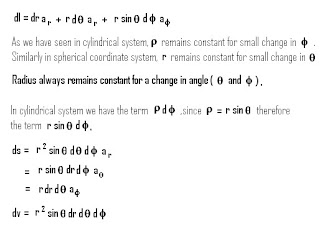
Always remember that for a small change in angle the radius remains constant. Radius of a cylinder (ρ) is constant for a small change in φ . Similarly the radius of a sphere (r) is constant for a small change in θ. Therefore ρ always associates dφ , and r always associates dθ. Differential Length (dl) : - dl = dra r + r dθa θ + ρ dφ a φ We know that ρ = rsinθ Therefore dl = dra r + r dθa θ + r sinθdφ a φ Differential length for a surface is given as: - dl = dra r + r dθa θ ---( For r - θ plane or φ constant plane) - dl = r dθa θ + r sinθdφa φ ---( For θ - φ plane or r constant plane) - dl = dra r + r sinθdφ a φ ---( For r - φ plane or θ constant plane) Differential length for a line parallel to r, θ and φ axis are respectively given as: - dl = dra r ---(For a line parallel to r axis) - dl = r dθa θ ---( For a line parallel to θ axis) ∫ dl = ∫ o π rdθ = r (π - 0) = π r This answer describes the circumference of a semi circle. ...

Spherical Coordinate System (r, θ, φ) - Field Theory

Image
Geographers specify a location on the Earth’s surface using three scalar values: longitude, latitude, and altitude. Both longitude and latitude are angular measures , while altitude is a measure of distance . Latitude, longitude, and altitude are similar to Spherical Co-ordinates. Spherical coordinates consist of one scalar value (r), with units of distance, while the other two scalar values (θ, φ) have angular units (degrees or radians). A Vector in Spherical System is represented as (A r A θ , A φ ) or A = A r a r + A θ a θ + A φ a φ Where a r , a θ and a φ are the unit vectors in r, θ and φ direction respectively. The physical significance of each parameter of spherical coordinates: - The value r expresses the distance of the point from origin (i.e. similar to altitude). It is the radius of the sphere. - The angle θ is the angle formed with the z- axis (i.e. similar to latitude). It is also called the co-latitude angle. It is measured clockwise. ...

Differential Analysis - Cylindrical Coordinate System - Field Theory.

Image
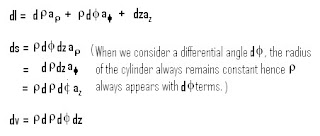
Differential Length(dl):   In General the differential length is given as dl = dρ a ρ + ρdφ a φ + dz a z Differential Length for a surface is given as: - dl = dρ a ρ + ρdφ a φ ---(For ρ-φ Plane or Z constant Plane) - dl = ρdΦ a φ + dz a z ---(For φ-z Plane or ρ Constant Plane) - dl = dρ a ρ + dz a z ---(For ρ-z Plane or φ Constant Plane) Differential length for a line parallel to ρ, φ and z axis are respectively given as: - dl = dρ a ρ ---(For a line parallel to ρ axis) - dl = ρdφ a φ ---(For a line parallel to φ axis) ∫ dl = ∫ o 2π ρdφ = ρ( 2π - 1) = 2πρ This resembles the circumference of a circle. Hence if φ varies with ρ and z constant, then the length is the circumference of the circle. dl = dza z ---(For a line parallel to z axis) Differential Surface (ds): - ds = ρdρ dφ a z   This surface describes a circular disc. Always remember- To define a circular disk we need two parameter one distance measure and one angular mea...