Posts

Eletromagnetics - Questions With Answers (Short Notes)

Image
1. Define A Uniform Plane Wave. Answer: In an uniform plane wave the electric and magnetic field vectors both lie in a plane and all such planes are parallel to each other. Also the amplitude and phase of vectors E and H are constant over the planes & they are always normal to the direction pf propagation. 2. State Gauss Divergence Theorem. Answer: This theorem states that the net flux of a vector field F over any closed surface S is equal to the volume integral of the divergence of that vector field over the volume enclosed by the surface S . Mathematically it is expressed as: 3. State Stoke’s Theorem. Answer: This theorem states that the line integral of vector field A around the closed curve forming the periphery of any surface S is equal to surface integral of the curl of that vector field taken over surface S bound by the curve forming periphery of the surface. Mathematically it is expressed as: 4. What Do You Understand By Displacement Current...
Magnetic Forces, Materials, and Devices - Questions With Answers (Short Notes)

Image
01. State Three Ways In Which Forces Due To Magnetic Fields Can Be Experienced? Answer: There are at least three ways in which force due to magnetic fields can be experienced. The force can be due to a moving charged particle in a magnetic field. on a current element in an external magnetic field. between two current elements. 02. State The Lorentz Force Equation? Answer: The Lorentz force equation relates the force acting on a particle with charge Q in the presence of EM fields. It expresses the fundamental law relating EM to mechanics. F = Q(E + u * B) = m ( du/dt) Based on the Lorentz force law, the force experienced by a current element Idl in a magnetic field B is dF = I dl * B From this, the magnetic field B is defined as the force per unit current element. 03. Define Magnetic Torque? Answer: The torque T (or mechanical moment of force) on the loop is the vector product of the force F and iho moment arm r. T = r X F and magnetic torque is meas...

Electric Fields In Material Space - Questions With Answers (Short Notes)

01. How Can Materials Be Classified In Terms Of Their Electrical Properties? Answer:  Materials can be classified roughly as conductors (σ >> 1, ε r = 1) and dielectrics ( σ << 1, ε r  ≥ 1 ) in terms of their electrical properties  σ  and  ε r  where  σ  is the conductivity and  ε r  is the dielectric constant or relative permittivity. A material with high conductivity ( σ >> 1) is referred to as a metal whereas one with low conductivity ( σ << 1 ) is referred to as an insulator. A material whose conductivity lies somewhere between those of metals and insulators is called a semiconductor. 02. Define Superconductor? Answer: The conductivity of metals generally increases with decrease in temperature. At temperatures near absolute zero (T = 0°K), some conductors exhibit infinite conductivity and are called superconductors. Lead and aluminum are typical examples of such metals. 03. Why...

Part I - Electric & Magnetic Field In Material Space - Questions With Answers (Short Notes)

Image
1. What Do You Mean By Dielectric Constant Of A Material ? Answer: Dielectric constant (k) or relative permittivity (ε r ) is defined as the ratio of capacitance of a capacitor with dielectric to the capacitance of same capacitor without dielectric. It generally describes the ability of a material to polarize and store a charge. Mathematically, k or ε r = C/C 0 . [Since C = q/V, we have ε r = E 0 /E = V 0 /V = ε/ε r ]. 2. Define Dielectric Medium. Answer: Dielectric is a material in which energy can be stored by the polarization of the molecules. It is a material that increases the capacitance or charge storage ability of a capacitor. Ideally, a dielectric is an insulator and does not contain free charge. However, in the presence of external field it exhibits a relative displacement of opposite bound charges and hence the polarization of the medium. Due to polarization induced surface charges tend to weaken the original field within the dielectric. [The resultan...

ElectroStatics - Questions With Answers (Short Notes)

Image
1. State Stokes Theorem. Answer: The line integral of a vector around a closed path is equal to the surface integral of the normal component of its curl over any surface bounded by the path ∫ H.dl = ∫ ∫ ( ∆ x H ) ds where, H is the Magnetic field intensity 2. State The Condition For The Vector F To Be Solenoidal. Answer: ∆ . F = 0 where, F = A i + B i + C i 3. State The Condition For The Vector F To Be Irrotational. Answer: ∆ x F = 0 where, F = A i + B i + C i 4. Give The Relationship Between Potential Gradient and Electric Field. Answer:  E = - ∆V where, E represents Electric Field Intensity and V represents Electric Potential 5. What Is The Physical Significance Of div D ? Answer: The divergence of a vector flux density is electric flux per unit volume leaving a small volume. This is equal to the volume charge density. 6. What Are The Sources Of Electric Field & Magnetic Field? Answer: Stationary charges produce electric field ...

State The Difference Between Conduction & Displacement Current?

Image
The differences between Conduction Current and displacement current are: 1. Conduction current obeys ohm's law as V = (I / R) but displacement current does not obey ohm's law. 2. Conduction current density is represented by  whereas displacement current density is given by 3. Conduction current is the actual current whereas displacement current is the apparent current produced by time varying electric field.

Antenna Theory - Solved Numerical's / Problems - ElectroMagnetic Theory...

Image
1) An electric field strength of 10 µV/m is to be measured at an observation point θ = π/2, 500 km from a λ/4 monopole antenna operating in air at 50 MHz. (a) What is the length of the dipole? (b) Calculate the current that must be fed to the antenna. (c) Find the average power radiated by the antenna. (d) If a transmission line with Z o  = 75 Ω is connected to the antenna, determine the standing wave ratio. --- For Solution    CLICK HERE . 2) Calculate the directivity of The Hertzian Monopole. The quarter-wave Monopole.   ---  For Solution    CLICK HERE . 3) A certain antenna with an efficiency of 95% has maximum radiation intensity of 0.5 W/sr. Calculate its directivity when (a) The input power is 0.4 W (b) The radiated power is 0.3 W      ---  For Solution    CLICK HERE . 4) Evaluate the directivity of an antenna with normalized radiation intensity    ---  For Solution  ...

Vector Analysis & Electrostatics - Index / Sitemap.

INDEX Vector analysis is a mathematical tool with which electromagnetic (EM) concepts are most conveniently expressed. It's important to learn its rules and techniques first applying it. VECTOR ALGEBRA: - Scalars and Vectors. - Unit Vectors. - Position and Distance Vectors. - Vector Multiplication. - Components Of a Vector. - Numericals / Solved Examples. COORDINATE SYSTEMS & TRANSFORMATION: In general, the physical quantities in ElectroMagnetics are functions of space and time. In order to describe the spatial variations of the quantities, its important to define all points uniquely in space in a suitable manner. This requires using an appropriate coordinate system. Hence its very important to understand the coordinate system first.  - Introduction To Coordinate System. - Cartesian Coordinate System / Rectangular Coordinate System (x, y, z). - Differential Analysis Of Cartesian Coordinate System. - Circular Cylindrical Coordinate System (ρ, φ, z)...

Transmission Lines - Solved Numericals / Problems - 2.

Image
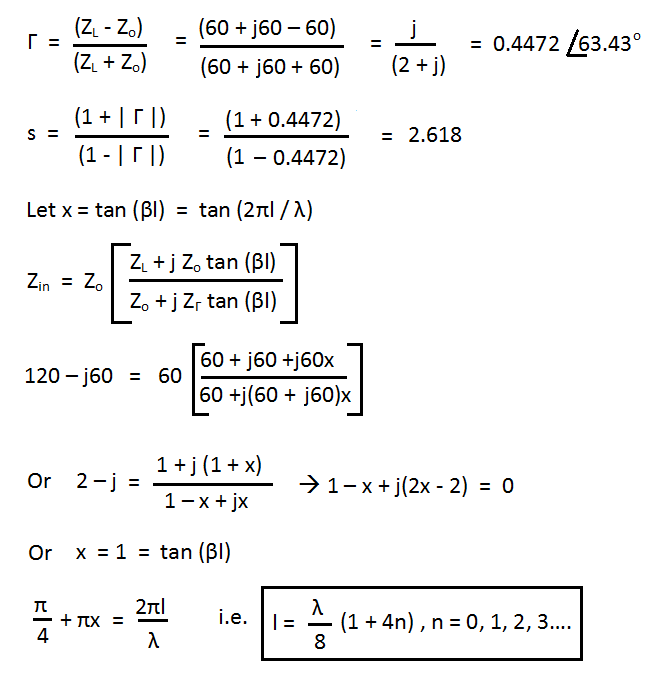
Q.4) A 70 Ω lossless line has s = 1.6 and θ Γ = 300 o . If the line is 0.6λ long, obtain (a) Γ, Z L , Z in (b) The distance of the first minimum voltage from the load Answer: a) Using the smith chart, locate S at s = 1.6. Draw a circle of radius OS. Locate P where θ Γ = 300 o . At P, | Γ | = OP / OQ = 2.1 cm / 9.2 cm = 0.228 Γ = 0.228 ∠300 o Also at P, Z L = 1.15 – j0.48, Z L = Z o  Z L = 70 (1.15 – j0.48) = 80.5 – j33.6 Ω l = 0.6 λ = 0.6 x 720 o = 432 o = 360 o + 72 o From P, move 432 o to R. At R, Z in = 0.68 – j0.25 Z in = Z o  Z in = 70 (0.68 – j0.25) = 47.6 – j17.5 Ω b) The maximum voltage (the only one) occurs at θ Γ = 180 o ; its distance from the load is      (180 – 60) λ / 720  =   λ / 6  =   0.1667 Ω Q.5) A lossless 60 Ω line is terminated by a 60 + j60 Ω load. (a) Find Γ and s. If Z in = 120 - j60 Ω, how far (in terms of wavelengths) is the load from the generat...

Solved Exercise/Numericals - Transmission Lines - 1.

Image
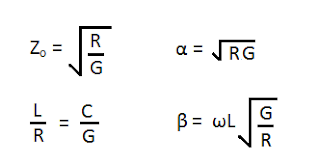
Q.1) A transmission line operating at 500 MHz has Z o = 80Ω, α = 0.04Np/m, β = 1.5 rad/m. Find the line parameters R, L, G and C. Answer: Since Z o is real & α ǂ 0, this is a distortionless line. R o = α Z o = 0.04 x 80 = 3.2 Ω / m G = α / Z o = 0.04 / 80 = 5 x 10⁻⁴ Ω / m L = β Z o / ω = 1.5 x 80 / (2 π x 5 x 108 ) = 38.2 nH / m C = L G / R = 38.2 x 10-9 x 5 x 10-4 / 3.2 = 5.97 pF / m Q.2) A telephone line R = 30 Ω /km, L = 100 mH/km, G = 0 , and C = 20 µF/km. At f = 1 kHz, obtain: a) The characteristics impedance of the line. b) The propagation constant. c) The phase velocity. Answer: Q.3) A 40 m long transmission line has V g = 15 ∠0 o V rms , Z o = 30 + j60 Ω, and V L = 5 ∠-48 o V rms . If the line is matched to the load, calculate: a) The input impedance Z in b) The sending end current I in and voltage V in c) The propagation constant γ Answer: a) Z g  =  Z 1  --> Z in ...

SOLVED Numerical's - Antenna Theory - Page 7.

Image
19) At the far field, an antenna produces Calculate the directive gain and the directivity of the antenna? SOLUTION: 20) For a thin dipole λ/16 long, find the a) Directive gain b) Directivity c) Effective area d) Radiation resistance SOLUTION: a) On substituting we get, G φ = 1.5 sin 2 θ b) Directivity , D = G φ, max = 1.5 c) Effective Area , A e = (λ 2 / 4π) G φ = (1.5 λ 2 sin 2 θ) / 4π d) Radiation Resistance R rad

SOLVED Numerical's - Antenna Theory - Page 6.

Image
16) Sketch the normalized E-field and H-field patterns for a. A half-wave dipole b. A quarter-wave monopole. SOLUTION: a) b) The same as for λ/2 dipole except that the fields are zero for θ > π/2 as shown: 17) In free space, an antenna has a far zone field given by Determine the radiated power? SOLUTION: 18) At the far field, the electric field produced by antenna is Sketch the vertical pattern of the antenna. Your plot should include as many points as possible. SOLUTION:        f(θ) = | cosθ cosφ |             For the vertical pattern, φ = 0 which means,                        f(θ) = | cosθ | which is sketched below

SOLVED Numerical's - Antenna Theory - Page 5.

Image
13) A 1-m-long car radio antenna operates in the AM frequency of 1.5 MHz. How much current is required to transmit 4 W of power? SOLUTION: This is a monopole antenna λ = c / f = (3 x 10⁸) / (1.5 x 10⁶) = 200 m In this case, it’s pretty clear that l << λ 14) An antenna located on the surface of a flat earth transmits an average power of 200 kW. Assuming that all the power is radiated uniformly over the surface of a hemisphere with the antenna at the center, calculate (a) The time-average Poynting vector at 50 km, and (b) The maximum electric field at that location. SOLUTION: a)      P rad = ∫ P rad . ∂s = P ave . 2πr 2 (hemisphere)      P ave = P rad / 2πr 2 = (200 x 10 3 ) / (2π 50 x 10 6 ) 2             =12.73 µW / m 2                                              P av...

SOLVED Numerical's - Antenna Theory - Page 4.

Image
9) A Hertzian dipole at the origin in free space has dl = 20 cm and I = 10 cos2π10 7 t A, find |E θs | at the distant point (100, 0, 0). SOLUTION: λ = c / f = ( 3 x 10⁸ ) / (107) = 30 m At (100, 0, 0), r = 100 m & θ = π / 2 10) A 2-A source operating at 300 MHz feeds a Hertzian dipole of length 5 mm situated at the origin. Find E s and H s at (10, 30°, 90°). SOLUTION:                    λ = c / f = (3 x 10⁸) / (3 x 10⁸) = 1m                    β = 2π / λ = 2π                   At r = 10, θ = 30 o , φ = 90 o                    λ = 120π = 377 m                    E θs = η H φs = 94.25 mV/m 11) An antenna can be modelled as an electric dipole of length 5 m at 3 MHz. Find the radiation resistance of...

SOLVED Numerical's - Antenna Theory - Page 3.

Image
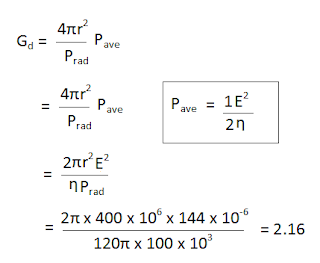
6) An antenna in air radiates a total power of 100 kW so that maximum radiated electric field strength of 12 mV/m is measured 20 km from the antenna.  Find its: (a) Directivity in dB (b) Maximum power gain if η r = 98%. SOLUTION: a) G = 10 log 10 G d = 10 log 10 (2.16) = 3.34 dB b) G = η r G d = 0.98 x 2.16 = 2.117 7) A C-band radar with an antenna 1.8 m in radius transmits 60 kW at a frequency of 6000 MHz. If the minimum detectable power is 0.26 mW, for a target cross section of 5 m 2 , calculate the maximum range in nautical miles and the signal power density at half this range. Assume unity efficiency and that the effective area of the antenna is 70% of the actual area. SOLUTION: 8) The magnetic vector potential at point P(r, θ, φ) due to a small antenna located at the origin is given by where r 2 = x 2 + y 2 + z 2 . Find E(r, θ, φ, t) and H(r, θ, φ, t) at the far field. SOLUTION: Using Vector transformation,     ...