Field Theory - Conductor ( Isolated and Non-Isolated) - Under the Influence Of Electric Field...

- A conductor (such as Copper, Aluminum, gold) contains electrons that are not bounded to the atom and are free to move within the material.

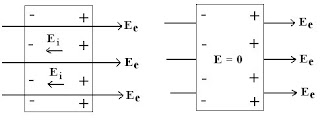
- When an isolated conductor is placed in an external electric field Ee, the negative charges (electrons) starts moving in the opposite direction to that of electric field.

- Soon the electrons get accumulated on the surface of one side of the conductor, while the surface on the other side gets depleted of electrons and hence acquire a positive charge (+ve).

- These separated negative (-ve) and positive charges (+ve) on the opposite sides of the conductor produces an internal induced electric field Ei which opposes the external field Ee inside the conductor.

- If the conductor is a perfect conductor or a good conductor the internal electric field Ei will cancel the external electric field Ee. Hence we can therefore say that

“A perfect conductor cannot contain an electrostatic field inside it.”


- There is a net field of zero magnitude inside the conductor. Hence if E = 0, then the electric flux through any arbitrary closed surface inside the conductor is also equal to zero. This immediately implies that the charge density ρv inside the conductor is equal to zero everywhere (Gauss's law).

- If any excess charge is placed within the volume of the conductor, the repulsive forces pushes them far apart. Since the farthest is the surface itself, all the excess charge resides entirely on the surface. Hence it’s clear that the net charge on an isolated conductor exits only on the surface.

- The electrostatic field at the conductor’s surface is proportional to the surface charge and does not depend on the charge carriers inside the conductor.


- It’s safe to be inside a car / automobile during a thunderstorm. Why?

Ans: Yes, because the metal body of the car carries the excess charge on its external surface. Also we know inside a closed conducting surface electric field is zero. Hence the metal body acts like a screen or shield for the occupants.


PROPERTIES OF AN ISOLATED CONDUCTOR (IN STATIC SITUATION):


- Electric field is zero everywhere within the conductor and also inside a closed conducting surface.

- Any excess charge resides only on the surface of the conductor.

- Electric field just outside the charged conductor is perpendicular to the conductor’s surface.

- On an irregular shaped conductor, the charges tend to accumulate at locations where the radius of curvature of the surface is smallest i.e. at sharp points. Hence we can also say that the field is strongest on the pointy parts of a conductor.

- There is no potential difference between any two points in the conductor i.e. a conductor is an equipotential body.


NON - ISOLATED CONDUCTOR

OR


CONDUCTOR IN A NON-ELECTROSTATIC EQUILIBRIUM:


- Consider a conductor having a uniform cross section S, length l and whose ends are maintained at a potential difference V as shown in the figure:

 
- When a potential difference of V is applied across the conductor, the electric field inside a conductor is not zero. Hence there is no static equilibrium inside a conductor.

- A conductor is said to be in electrostatic equilibrium only if no electric field exist inside a conductor.

- Since E ≠ 0, the free charges in the conductor start moving, thus producing conduction current.

- As the electrons moves from one end to another, they experience a damping force called Resistance.


- The electric field E applied is uniform (since V is constant) and is related to electric potential V as:

E = V / l

- Since the conductor has a uniform cross section, the current density is given as:

J = I / S

- Also conduction current density (J) is given as:

J = σ E

- Hence substituting the value of J in the above equation, we have

I = σ E S

Equating the expressions for E

E = V / l = I / σ S

→ V = (l / σ S) I

→ V = I R

- Hence Resistance of a conductor is given as:

R = l / σ S = ρ l / S

Where σ is the conductivity and ρ is the resistivity of the conductor.

- For a conductor of non-uniform cross section , the resistance is given as:


Your suggestions and comments are welcome in this section. If you want to share something or if you have some stuff of your own, please do post them in the comments section.

Field Theory - Conduction And Convection Current Density....


CONVECTION CURRENT DENSITY:


- Convection current occurs in insulators or dielectrics such as liquid, vacuum and rarified gas.

- Convection current results from motion of electrons or ions in an insulating medium.

- Since convection current doesn’t involve conductors, hence it does not satisfy ohm’s law.


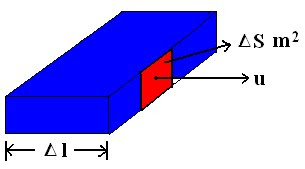
- Consider a filament where there is a flow of charge ρv at a velocity u = uy ay.


- Hence the current is given as:


Where uy is the velocity of the moving electron or ion and ρv is the free volume charge density.

- Hence the convection current density in general is given as:

J = ρv u


CONDUCTION CURRENT DENSITY:


- Conduction current occurs in conductors where there are a large number of free electrons.

- Conduction current occurs due to the drift motion of electrons (charge carriers).

- Conduction current obeys ohm’s law.

- When an external electric field is applied to a metallic conductor, conduction current occurs due to the drift of electrons.

- The charge inside the conductor experiences a force due to the electric field and hence should accelerate but due to continuous collision with atomic lattice, their velocity is reduced.


- The net effect is that the electrons moves or drifts with an average velocity called the drift velocity (υd) which is proportional to the applied electric field (E).

- Hence according to Newton’s law, if an electron with a mass m is moving in an electric field E with an average drift velocity υd, the the average change in momentum of the free electron must be equal to the applied force (F = - e E).


- The drift velocity per unit applied electric field is called the mobility of electrons (μe).

υd = - μe E


where μe is defined as:


- Consider a conducting wire in which charges subjected to an electric field are moving with drift velocity υd.

- Say there are Ne free electrons per cubic meter of conductor, then the free volume charge density(ρv) within the wire is

ρv = - e Ne


- The charge ΔQ is given as:

ΔQ = ρv ΔV = - e Ne ΔS Δl = - e Ne ΔS υd Δt

- The incremental current is thus given as:


- The conduction current density is thus defined as:


where σ is the conductivity of the material.

- The above equation is known as the Ohm’s law in point form and is valid at every point in space.

- In a semiconductor, current flow is due to the movement of both electrons and holes, hence conductivity is given as:

σ = ( Ne μe + Nh μh )e


- ... Back To Index.

NEXT TOPIC:

- Conductor Under The Influence Of An Applied Electric Field (E).


Your suggestions and comments are welcome in this section. If you want to share something or if you have some stuff of your own, please do post them in the comments section.

Field Theory - Properties Of Materials And Steady Electric Current...

- Electric field can not only exist in free space and vacuum but also in any material medium.

- When an electric field is applied to the material, the material will modify the electric field either by strengthening it or weakening it, depending on what kind of material it is.

- Materials are classified into 3 groups based on conductivity / electrical property:
 
          - Conductors (Metals like Copper, Aluminum, etc.) have high conductivity (σ >> 1).
          - Insulators / Dielectric (Vacuum, Glass, Rubber, etc.) have low conductivity (σ << 1).
          - Semiconductors (Silicon, Germanium, etc.) have intermediate conductivity.


- Conductivity (σ) is a measure of the ability of the material to conduct electricity. It is the reciprocal of resistivity (ρ).

- Units of conductivity are Siemens/meter and mho.

- The basic difference between a conductor and an insulator lies in the amount of free electrons available for conduction of current.

- Conductors have a large amount of free electrons where as insulators have only a few number of electrons for conduction of current.

- Most of the conductors obey ohm’s law. Such conductors are also called ohmic conductors.


- Due to the movement of free charges, several types of electric current can be caused. The different types of electric current are:

          - Conduction Current.
          - Convection Current.
          - Displacement Current.


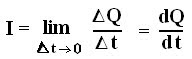
- Electric current (I) defines the rate at which the net charge passes through a wire of cross sectional surface area S.

Mathematically,
If a net charge ΔQ moves across surface S in some small amount of time Δt, electric current(I) is defined as:


- How fast or how speed the charges will move depends on the nature of the material medium.

- Current density (J) is defined as current ΔI flowing through surface ΔS.

- Imagine surface area ΔS inside a conductor at right angles to the flow of current. As the area approaches zero, the current density at a point is defined as:

 
The above equation is applicable only when current density (J) is normal to the surface.


- In case if current density(J) is not perpendicular to the surface, consider a small area ds of the conductor at an angle θ to the flow of current as shown:


In this case current flowing through the area is given as:

dI = J dS cosθ = J . dS

I = S (J . dS)

where angle θ is the angle between the normal to the area and direction of the current.

From the above equation it’s clear that electric current is a scalar quantity.


- ... Back To Index.

NEXT TOPIC:

- Conduction and Convection Current Density.

- Conductor Under The Influence Of An Applied Electric Field (E).


Your suggestions and comments are welcome in this section. If you want to share something or if you have some stuff of your own, please do post them in the comments section.

Field Theory - Numericals / Solved Examples - Electrostatic Energy and Energy Density...

Q.1 Point charges Q1 = 1 nC, Q2 = -2 nC and Q3 = 3 nC and are positioned one at a time and in that order at (0, 0, 0), (1, 0, 0) and (0, 0, -1) respectively. Calculate the energy in the system after each charge is positioned?
Ans:

Initially the system is assumed to be charge free.

The energy required to bring Q1 into the system is 0 J.

After Q1: Energy in the system = 0 J

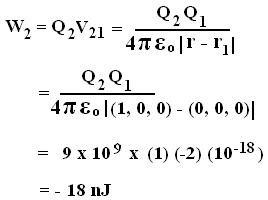
The energy required to bring Q2 into the system is


Hence, After Q2: Energy in the system = -18 nJ

The energy required to bring Q3 into the system is:

W3 = Q3 ( V31 + V32 ) + Q2 V21


Q2. Determine the work necessary to transfer charges Q1 = 1 mC and Q2 = -2 mC from infinity to points (-2, 6, 1) and (3, -4, 0) respectively.
Ans:

No work is done in transferring the first charge Q1. However work done to transfer the point charge Q2 is given as:


Q3. A point charge Q is placed at the origin. Calculate the energy stored in region r > a?
Ans:

Work done in assembling a volume charge distribution in terms of electric field and flux density is given as:


Electric field intensity due to a point charge Q placed at origin is given as:


Hence energy stored in a region r > a is given as:


- ... Back To Index.


Your suggestions and comments are welcome in this section. If you want to share something or if you have some stuff of your own, please do post them in the comments section.

Field Theory - Energy Density In Electrostatic Field / Work Done To Assemble Charges....

- In case, if we wish to assemble a number of charges in an empty system, work is required to do so.

- Also electrostatic energy is said to be stored in such a collection.

- Let us build up a system in which we position three point charges Q1, Q2 and Q3 at position r1, r2 and r3 respectively in an initially empty system.

- Consider a point charge Q1 transferred from infinity to position r1 in the system. It takes no work to bring the first charge from infinity since there is no electric field to fight against (as the system is empty i.e. charge free).

Hence, W1 = 0 J


- Now bring in another point charge Q2 from infinity to position r2 in the system. In this case we have to do work against the electric field generated by the first charge Q1.

Hence, W2 = Q2 V21

where V21 is the electrostatic potential at point r2 due to Q1.

- Work done W2 is also given as:


- Now bring in another point charge Q3 from infinity to position r3 in the system. In this case we have to do work against the electric field generated by Q1 and Q2.

Hence, W3 = Q3 V31 + Q3 V32 = Q3 ( V31 + V32 )

where V31 and V32 are electrostatic potential at point r3 due to Q1 and Q2 respectively.

- The work done is simply the sum of the work done against the electric field generated by point charge Q1 and Q2 taken in isolation: 


- Thus the total work done in assembling the three charges is given as:

WE = W1 + W2 + W3
                               = 0 + Q2 V21 + Q3 ( V31 + V32 )

- Also total work done ( WE ) is given as:


- If the charges were positioned in reverse order, then the total work done in assembling them is given as:

WE = W3 + W2+ W1
                            = 0 + Q2V23 + Q3( V12+ V13)

where V23 is the electrostatic potential at point r2 due to Q3 and V12 and V13 are electrostatic potential at point r1 due to Q2 and Q3 respectively.

- Adding the above two equations we have,

2WE = Q1 ( V12 + V13) + Q2 ( V21 + V23) + Q3 ( V31 + V32)
                                          = Q1 V1 + Q2 V2 + Q3 V3


Hence
WE =1 / 2 [Q1V1 + Q2V2 + Q3V3]

where V1, V2 and V3 are total potentials at position r1, r2 and r3 respectively.

- The result can be generalized for N point charges as:


- The above equation has three interpretation:
   
          a) This equation represents the potential energy of the system.
      
          b) This is the work done in bringing the static charges from infinity and assembling them in the required system.
     
          c) This is the kinetic energy which would be released if the system gets dissolved i.e. the charges returns back to infinity.


- In place of point charge, if the system has continuous charge distribution ( line, surface or volume charge), then the total work done in assembling them is given as:


- Since ρv = ∇ . D and E = - ∇ V,

Substituting the values in the above equation, work done in assembling a volume charge distribution in terms of electric field and flux density is given as:


- The above equation tells us that the potential energy of a continuous charge distribution is stored in an electric field.

- The electrostatic energy density wE is defined as:


- ... Back To Index.

NEXT TOPIC:

- Numericals / Solved Examples - Electrostatic Energy and Energy Density....


Your suggestions and comments are welcome in this section. If you want to share something or if you have some stuff of your own, please do post them in the comments section.

Field Theory - Numericals/Solved Examples - Electric Potential, Potential Gradient and Electric dipole...

Q.1 Determine the electric field due to the following potential:
a) V = x2 + 2y2 + 4z2
Ans:


= - (2x ax + 4y ay + 8z az )
= -2x ax - 4y ay - 8z az V/m

b) V = ρ2 (z + 1) sinφ


= - [ 2ρ (z + 1)sinφ aρ + ρ(z + 1) cosφ aφ + ρ2 sinφ az ]
= - 2ρ (z + 1)sinφ aρ - ρ(z + 1) cosφ aφ - ρ2 sinφ az


Q.2 A point charge of 5 nC is located at the origin. If V = 2v at (0, 6, -8), find
a) The potential at A (-3, 2, 6)
b) The potential at B (1, 5, 7)
c) The potential difference VAB
Ans:
If V (0, 6, -8) = 2 V
In this case
x = 0; y = 6; z = -8

Using the scalar relationship between Cartesian and spherical system, we have

r = (x2 + y2 +z2)1/2 = (100)1/2 =10

Hence

Electric potential at point r due to a point charge Q located at origin


→ C = - 2.5

a) Electric potential at point r due to a point charge Q located at a point (-3, 2, 6) is given as:


= 3. 929 V

b) Electric potential at point r due to a point charge Q located at a point (1, 5, 7) is given as:


= 2.696 V

c) The potential difference VAB is given as:

VAB = VB – VA = 2.696 – 3.929 = - 1.233 V


Q.3 If point charge 3 μC is located at the origin. Also there are two more charges -4 μC and 5 μC are located at (2, -1, 3) and (0, 4, -2) respectively. Find potential at (-1, 5, 2) ? Assume zero potential at infinity.
Ans:
For N point charges Q1, Q2 ….Qn located at points with position vectors r1, r2, r3…..rn, the electric potential at point r is given as:


At V ( ∞ ) = 0, C = 0

| r – r1 | = | (-1, 5, 2) – (2, -1, 3) | = (46)1/2
| r – r2 | = | (-1, 5, 2) – (0, 4, -2) | = (18)1/2
| r – r3 | = | (-1, 5, 2) – (0, 0, 0) | = (30)1/2

Hence electric potential is given as:


= 10.3 kV


Q.4 An electric dipole of 100 az pC.m is located at the origin. Find V and E at points
a) (0, 0, 10)
b) (1, π/3, π/2)
Ans:
a) At point (0, 0, 10)
Cartesian → Spherical
(x, y, z) → (r, θ, φ)

(0, 0, 10) → (10, 0o, 0o)

Electric potential (V) due to a electric dipole centered at origin and aligned with the z axis is written as:


Electric field intensity (E) is the negative gradient of Electric Potential (V).


b)At point (1, π/3, π/2)

Electric potential (V) due to a electric dipole centered at origin and aligned with the z axis is written as:


Electric field intensity (E) is the negative gradient of Electric Potential (V).


- ... Back To Index.

NEXT TOPIC:

- Energy Density In Electrostatic Field / Work Done To Assemble Charges.....

- Numericals / Solved Examples - Electrostatic Energy and Energy Density....


Your suggestions and comments are welcome in this section. If you want to share something or if you have some stuff of your own, please do post them in the comments section.

Google Search - Blog