Spherical Co-ordinate System...

Geographers specify a location on the Earth’s surface using three scalar values:
longitude, latitude, and altitude.

Both longitude and latitude are angular measures, while altitude is a measure of distance.

Latitude, longitude, and altitude are similar to Spherical Co-ordinates.

Spherical coordinates consist of one scalar value (r), with units of distance, while the other two scalar values (θ, φ) have angular units (degrees or radians).

A Vector in Spherical System is represented as
(Ar Aθ, Aφ)
or
A = Arar + Aθaθ + Aφaφ

Where ar, aθ and aφ are the unit vectors in r, θ and φ direction respectively.

The physical significance of each parameter of spherical coordinates:


- The value r expresses the distance of the point from origin (i.e. similar to altitude). It is the radius of the sphere.

- The angle θ is the angle formed with the z- axis (i.e. similar to latitude). It is also called the co-latitude angle. It is measured clockwise.

- The angle φ, also called the azimuthal angle, indicates the rotation angle around the z-axis (i.e. similar to longitude). It is basically measured from the x axis in the x-y plane. It is measured counter-clockwise.


Range of the variables:

It defines the minimum and the maximum value that r, θ and φ can have in spherical co-ordinate system.

- 0 ≤ r ≤ ∞
- 0 ≤ θ ≤ π
- 0 ≤ φ ≤ 2π

Spherical System - Unit Vectors:

Since the co-ordinate system is orthogonal, the unit vectors  
ar, aθ and aφ are mutually perpendicular to each other.

- ar points in the direction of increasing r i.e.
    ar points away from the z-axis.
- aθ points in the direction of increasing θ.
- aφ points in the direction of increasing φ.

Consider the parallelogram ABOC,

- X = ρcos φ.
- Y = ρsin φ.
- Z = Z.

Consider the second parallelogram OCPQ, we have

- ρ = r sin θ
- z = r cos θ

So from the above data available we can say,

- x = r sin θ cos φ.
- Y = r sin θ sin φ.
- Z = r cos θ.

Similarly relationship between spherical and cylindrical coordinates can be derived as:


Relationship between (ax, ay, az) and (ar, aθ, aφ)


From the cylindrical coordinate system we know that,

ax = cosφ aρ – sinφ aφ
ay = sinφ aρ + cosφ aφ
az = az

From the above figure, we can write aρ in terms of ar and aθ as

aρ = cos (90o – θ) ar + cos θ aθ
az = cos θ ar - sin θ aθ  

Hence the unit vectors of cartesian and spherical co-ordinate system are related as:


ax = sin θ cos φ ar + cos θ cos φ aθ - sin φ aφ
ay = sin θ sin φ ar + cos θ sin φ aθ + cos φ aφ
az = cos θ ar - sin θ aθ

Transformation of vector A from (Ar, Aθ, AФ) to (Ax, Ay, Az) i.e. transformation of Vector A from Spherical to Cartesian can be obtained as    
Transformation of vector A from (Ax, Ay, Az) to (Ar, Aθ, AФ) i.e. transformation of Vector A from Cartesian to Spherical can be obtained as    
For more Information check out the following links:

- Spherical coordinate system - Wikepedia.

- Spherical coordinate system - Wolfram Mathworld.

  NEXT TOPIC:

- Differential Analysis (dl, ds, dv)- Spherical Coordinate System.

- Page 1 - Numericals on Coordinate system and Transformation.

- Page 2 - Numericals on Coordinate system and Transformation.

Your suggestions and comments are welcome in this section. If you want to share something or if you have some stuff of your own, please do post them in the comments section.

Field Theory - Differential Analysis - Cylindrical Co-ordinate System...


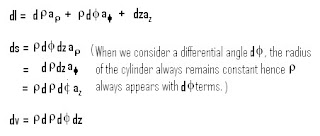
Differential Length(dl):
 

In General the differential length is given as

dl = dρ aρ + ρdφ aφ+ dz az


Differential Length for a surface is given as:


- dl = dρ aρ+ ρdφ aφ ---(For ρ-φ Plane or Z constant Plane)

- dl = ρdΦ aφ+ dz az ---(For φ-z Plane or ρ Constant Plane)

- dl = dρ aρ+ dz az ---(For ρ-z Plane or φ Constant Plane)

Differential length for a line parallel to ρ, φ and z axis are respectively given as:


- dl = dρ aρ ---(For a line parallel to ρ axis)

- dl = ρdφ aφ ---(For a line parallel to φ axis)

dl =o ρdφ = ρ( 2π - 1) = 2πρ

This resembles the circumference of a circle. Hence if φ varies with ρ and z constant, then the length is the circumference of the circle.

dl = dzaz ---(For a line parallel to z axis)


Differential Surface (ds):

- ds = ρdρ dφ az
 

This surface describes a circular disc. Always remember- To define a circular disk we need two parameter one distance measure and one angular measure. An angular parameter will always give a curved line or an arc.

In this case dΦ is measured in terms of change in arc.

Arc is given as:
Arc= radius * angle


Therefore, whenever there is a change in angle the radius always remains constant. Hence ρ always assist dφ.


ds = oρo ρ dρ dφ = (ρ2/2) (2π -1) = π ρ2

This answer describes the surface area of a circle. Hence the surface is a circular disc.


- ds = ρdφ dz aρ
 
This surface describes the curved surface of the cylinder. We can also say that this surface defines a hollow cylinder.

Suppose the height of the cylinder varies from 0 to h.

ds = oho ρ dφ dz = ρ (h - 0) (2π - 0) = 2 πρh

This answer describes the surface area of a cylinder. Hence the surface is a hollow cylinder.


- ds = dρ dz aφ
 
This surface describes a simple ρ-z plane which is along the direction of φ.


Differential Volume (dv):

dv = ρdρ dφ dz ---(Scalar Quantity)

dv = oρ o oh ρ dρ dφ dz = (ρ2/2) (2π -0) (h -0) = π ρ2 h

This answer describes the volume of a cylinder. 


- ... Back To Index.

NEXT TOPIC:

- Page 1 - Numericals on Coordinate system and Transformation.

- Page 2 - Numericals on Coordinate system and Transformation.

- ... Back to Cylindrical Coordinate System.


Your suggestions and comments are welcome in this section. If you want to share something or if you have some stuff of your own, please do post them in the comments section.

Field Theory - Circular Cylindrical Co-ordinate System...

A Vector in Cylindrical system is represented as
(Aρ, Aφ, Az)
or
A = Aρaρ+ Aφaφ+ Azaz

Where aρ, aφand az are the unit vectors in ρ, φ and z direction respectively.

The physical significance of each parameter of cylindrical coordinates:

- The value ρ indicates the distance of the point from the z-axis. It is the radius of the cylinder.

- The value φ, also called the azimuthal angle, indicates the rotation angle around the z-axis. It is basically measured from the x axis in the x-y plane. It is measured anti-clockwise.


- The value z indicates the distance of the point from z-axis. It is the same as in the Cartesian system. In short, it is the height of the cylinder.


Range of the variables:

It defines the minimum and the maximum value that ρ, φ and z can have in Cartesian system.

 0 ≤ ρ ≤
 0 ≤ φ ≤ 2π
- ≤ z ≤

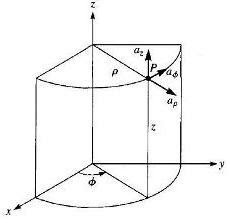
 Figure shows Point P and Unit vectors in Cylindrical Co-ordinate System.


Cylindrical System - Unit vectors:
Since the co-ordinate system is orthogonal, the unit vectors aρ, aφ and az are mutually perpendicular to each other.
- aρ points in the direction of increasing ρ, i.e aρ points away from the z-axis.
- aφ points in the direction of increasing φ (anticlockwise).
- az points in the direction of increasing z.


Relationship between Cylindrical and Cartesian Co-ordinate System Parameters:


Consider the parallelogram ABOC,

X = ρcosφ.
Y = ρsinφ.
Z = Z.


From the above equations we have,


Relationship between (ax, ay and az) and (aρ , aφand az) :

Since az is common between the two coordinate system, our main focus is to find out the relation between ax, ay and aρ , aφ

We know φ is the angle from the x-axis on the x-y plane.

From the above figures two equations can be deduced,


Transformation of vector A from (Ax, Ay, Az) to (Aρ, Aφ, Az) i.e. transformation of Vector A from Cartesian to Cylindrical can be obtained as


Transformation of vector A from (Aρ, Aφ, Az) to (Ax, Ay, Az) i.e. transformation of Vector A from Cylindrical to Cartesian can be obtained as


For more Information check out the following links:

- Cylindrical coordinate system - Wikepedia.

- Cylindrical coordinate system - Wolfram Mathworld.

NEXT TOPIC:

- ... Back To Index.

- Differential Analysis (dl, ds, dv)- Cylindrical Coordinate System.

- Page 1 - Numericals on Coordinate system and Transformation.

- Page 2 - Numericals on Coordinate system and Transformation.

Your suggestions and comments are welcome in this section. If you want to share something or if you have some stuff of your own, please do post them in the comments section.

Field Theory - Cartesian Co-ordinate System / Rectangular Co-ordinate System (X, Y, Z)


A Vector in Cartesian system is represented as
(Ax, Ay, Az)Or
A = Axax+ Ayay+ Azaz
Where ax, ay and az are the unit vectors in x, y, z direction respectively.


Range of the variables:

It defines the minimum and the maximum value that x, y and z can have in Cartesian system.

-∞ ≤ x,y,z ≤ ∞

Differential Displacement / Differential Length (dl):

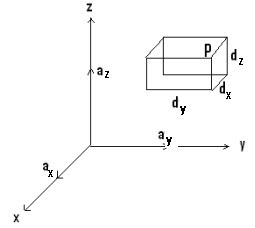
It is given as dl = dxax + dyay + dzaz


Differential length for a surface is given as:

dl = dxax + dyay --- ( For XY Plane or Z Constant Plane).
dl = dyay + dzaz, ---( For YZ Plane or X Constant Plane).
dl = dxax + dzaz ---( For XZ Plane or Y Constant Plane).

Differential length for a line parallel to x, y and z axis are respectively given as:

dl = dxax ---( For a line parallel to x-axis).
dl = dyay ---( For a line Parallel to y-axis).
dl = dzaz, ---( For a line parallel to z-axis).


If there is a wire of length L in z-axis, then the differential length is given as dl = dz az. Similarly if the wire is in y-axis then the differential length is given as dl = dy ay.


Differential Normal Surface (ds):

The differential surface (area element) is defined as ds = ds an, where an is the unit vector perpendicular to the surface.

For the 1st figure, ds = dydz ax
2nd figure, ds = dxdz ay
3rd figure, ds = dxdy az


Differential surface is basically a cross product between two parameters of the surface. For example, consider the first figure. The surface has two differential lengths, one is dy and dz. The differential surface (ds) is hence given as:
Where an is the unit vector normal to both dy and dz
i.e. an = ay * az = ax

In other words the differential surface element (ds) has an area equal to product dydz, and a normal vector that points in ax direction.


Differential Volume element (dv)

The differential volume element (dv) can be expressed in terms of the triple product.

dv = dx . (dy * dz)

Consider a cubical surface having dimension x * y * z. The differential volume (dv) of the cubical surface is given as the triple product of the dimensions.

dv = dx . (dy * dz)
= dx ax . (dy dz a xsin θ AB )
= dx ax . (dy dz a x)
= dx dy dz

Where dy and dz are mutually perpendicular to each other. Therefore the angle between them is 90o.

One thing to remember isthat, the three parameters of Cartesian coordinate system i.e. X, Y, Z are all mutually perpendicular to each other.

Therefore ax, ay and az are all mutually perpendicular to each other.


- ... Back To Index.


For more Information, check out the following links:

- Cartesian co-ordinate system - Wikepedia.

- Understanding Cartesian co-ordinate system with diagrams.

NEXT TOPIC:

- Cylindrical Coordinate System.

- Differential Analysis (dl, ds, dv)- Cylindrical Coordinate System.

- Spherical Coordinate System.

- Differential Analysis (dl, ds, dv)- Spherical Coordinate System.


Your suggestions and comments are welcome in this section. If you want to share something or if you have some stuff of your own, please do post them in the comments section.

Field Theory - Introduction to Co-ordinate System....

In order to describe the spatial variations of the quantities, appropriate coordinate system is required.

- A point or vector can be represented in a curvilinear coordinate system that may be orthogonal or non-orthogonal.

- An orthogonal system is one in which the coordinates are mutually perpendicular to each other.

- The different co-ordinate system available are:

- Cartesian or Rectangular.
- Circular cylindrical.
- Spherical.
- Elliptical Cylindrical.
- Hyperbolic Cylindrical.
- Parabolic Cylindrical .


The choice depends on the geometry of the application.


The frequently used and hence discussed herein are

- Rectangular Co-ordinate system.(Example: Cube, Cuboid)
- Cylindrical Co-ordinate system.(Example : Cylinder)
- Spherical Co-ordinate system.(Example : Sphere)


- A set of 3 scalar values that define position and a set of unit vectors that define direction form a co-ordinate system.


- The 3 scalar values used to define position are called co-ordinates. All coordinates are defined with respect to an arbitrary point called the origin.


- The 3 unit vectors used to define direction are also called base vectors.


- ... Back To Index.


For more Information, check out the following links:

- Co-ordinate System - Wikepedia.

- Co-ordinate - Wolfram MathWorld.


NEXT TOPIC:

- ... Back To Index.

- Cartesian Coordinate System.

- Cylindrical Coordinate System.

- Spherical Coordinate System.


Your suggestions and comments are welcome in this section. If you want to share something or if you have some stuff of your own, please do post them in the comments section.

Google Search - Blog